AI Generated Image
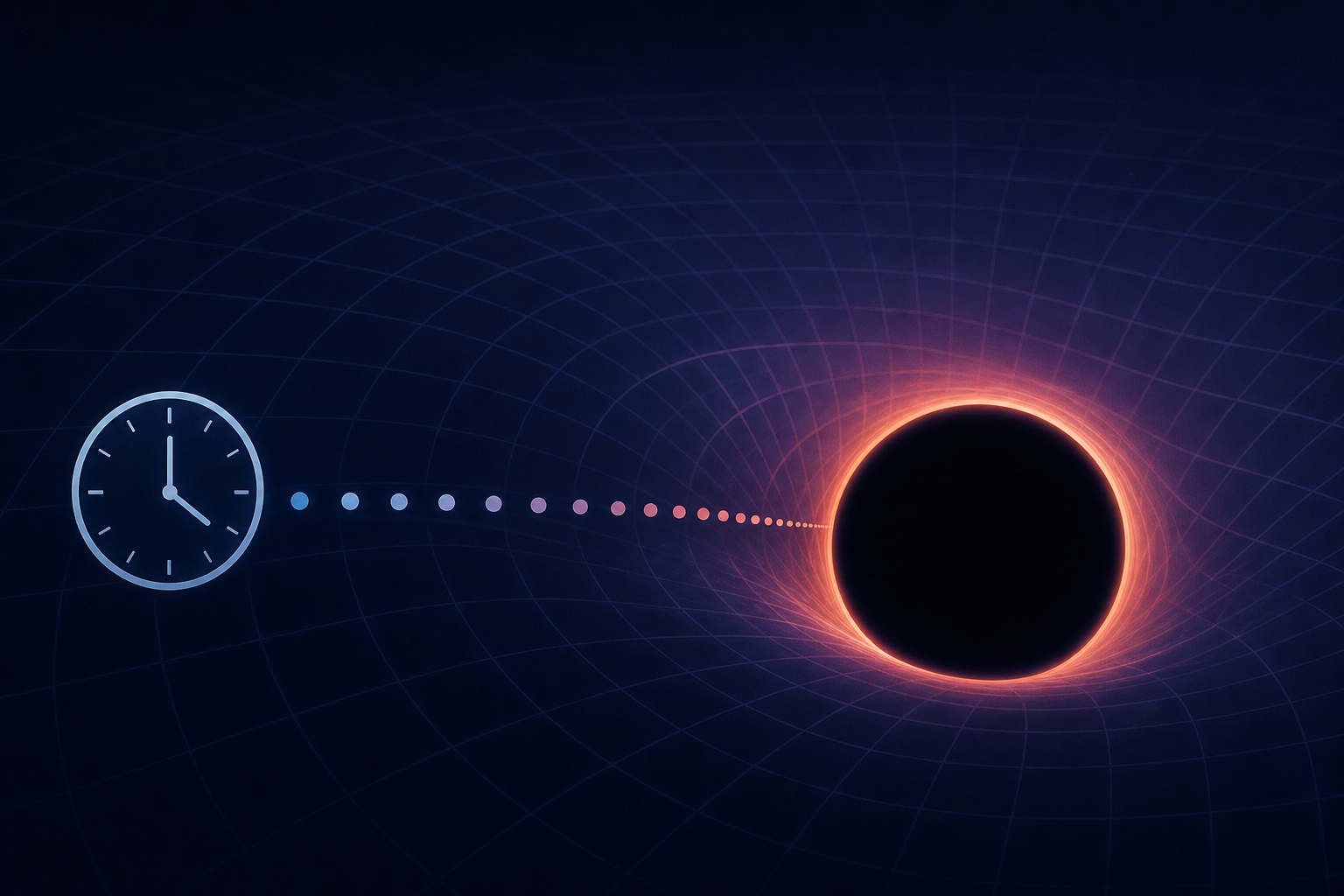
A black hole does not merely bend space; it bends time, pulling it so severely that at the event horizon, time as experienced from the outside appears to stop entirely, meaning something falling in wo
Space Daily • • science
Key Points:
- Gravitational time dilation, where clocks run slower in stronger gravitational fields, is a well-confirmed prediction of general relativity, demonstrated in laboratory experiments and accounted for in GPS satellite technology.
- Near a black hole, time dilation becomes extreme: to a distant observer, an object falling in appears to freeze at the event horizon, while the object itself crosses the horizon in finite proper time without local dramatic effects.
- The "frozen" image of an object at the event horizon is a mathematical limit; in reality, the object's light reddens and dims rapidly, making it invisible to distant observers almost immediately.
- Classical general relativity explains these effects but does not incorporate quantum mechanics, leaving unresolved questions about what happens inside the horizon and at the singularity, where a unified theory of quantum gravity is needed.
- Observations such as black hole images from the Event Horizon Telescope and gravitational waves from LIGO support general relativity's predictions but do not show objects frozen at horizons, highlighting the difference between theoretical descriptions and actual observations.


