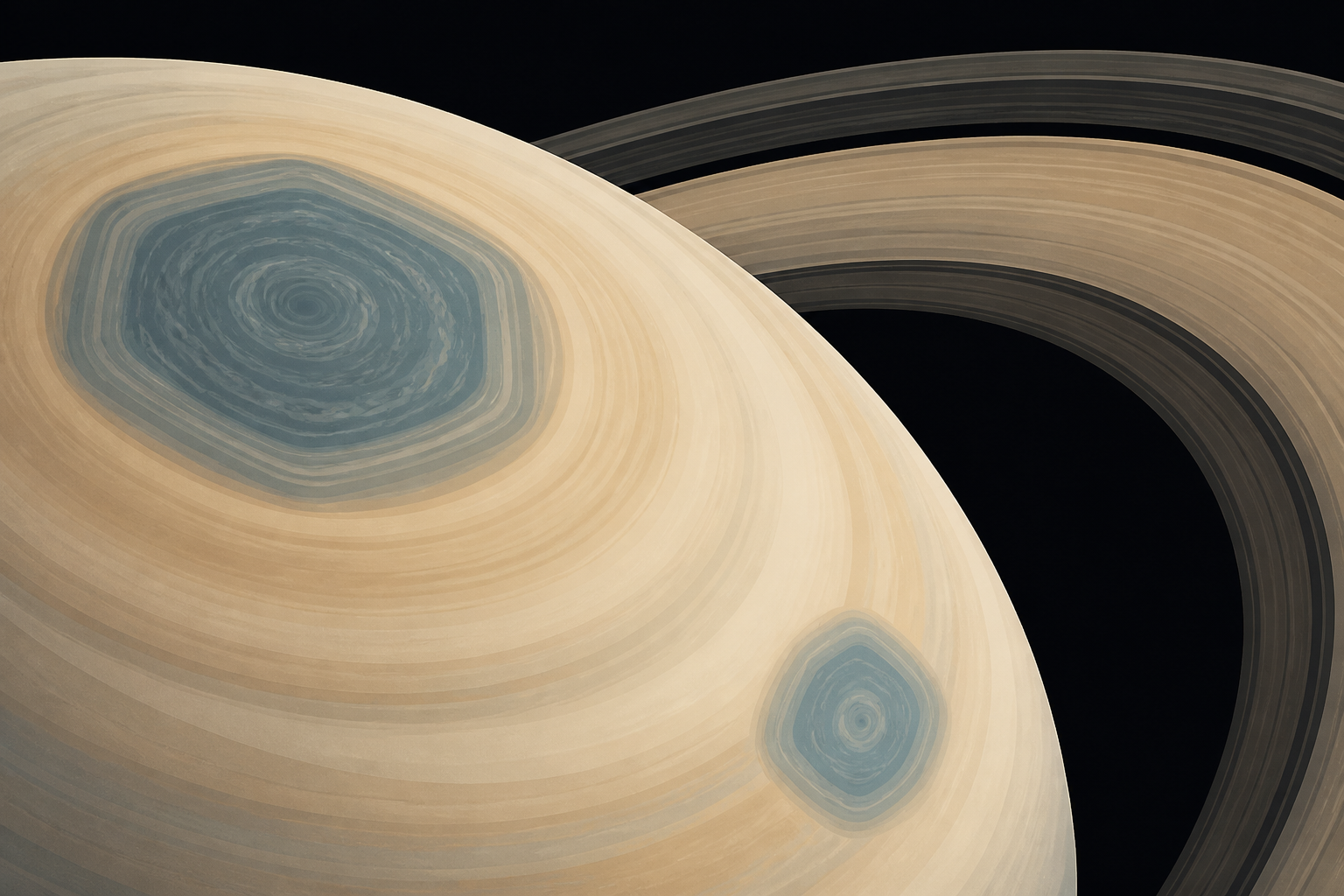
AI Generated Image
A Giant Hexagon Has Been Spinning at Saturn’s North Pole for Decades. Now, Scientists Found Its Twin
Gizmodo • • general
Key Points:
- NASA's Voyager spacecraft discovered a massive, six-sided storm at Saturn's north pole in 1980, a feature that has remained stable for over 40 years and is twice as wide as Earth.
- Recent Hubble space telescope images have revealed a new, growing 10-sided storm at Saturn's south pole, first observed between 2023 and 2025, marking a significant and surprising atmospheric development.
- Unlike the stable northern hexagon, the southern decagon's vertices shift over a 32-day cycle, indicating a dynamic, meandering wave rather than a rigid structure, suggesting complex atmospheric behavior.
- Scientists used shallow-water model simulations to propose that the decagon may have formed from disturbances along a jet stream or influenced by a nearby rotating vortex, implying it could be a transient phenomenon.
- This discovery offers fresh insights into storm formation and evolution on Saturn, enhancing understanding of planetary atmospheric dynamics and adding complexity to the longstanding mystery of Saturn's polar storms.


