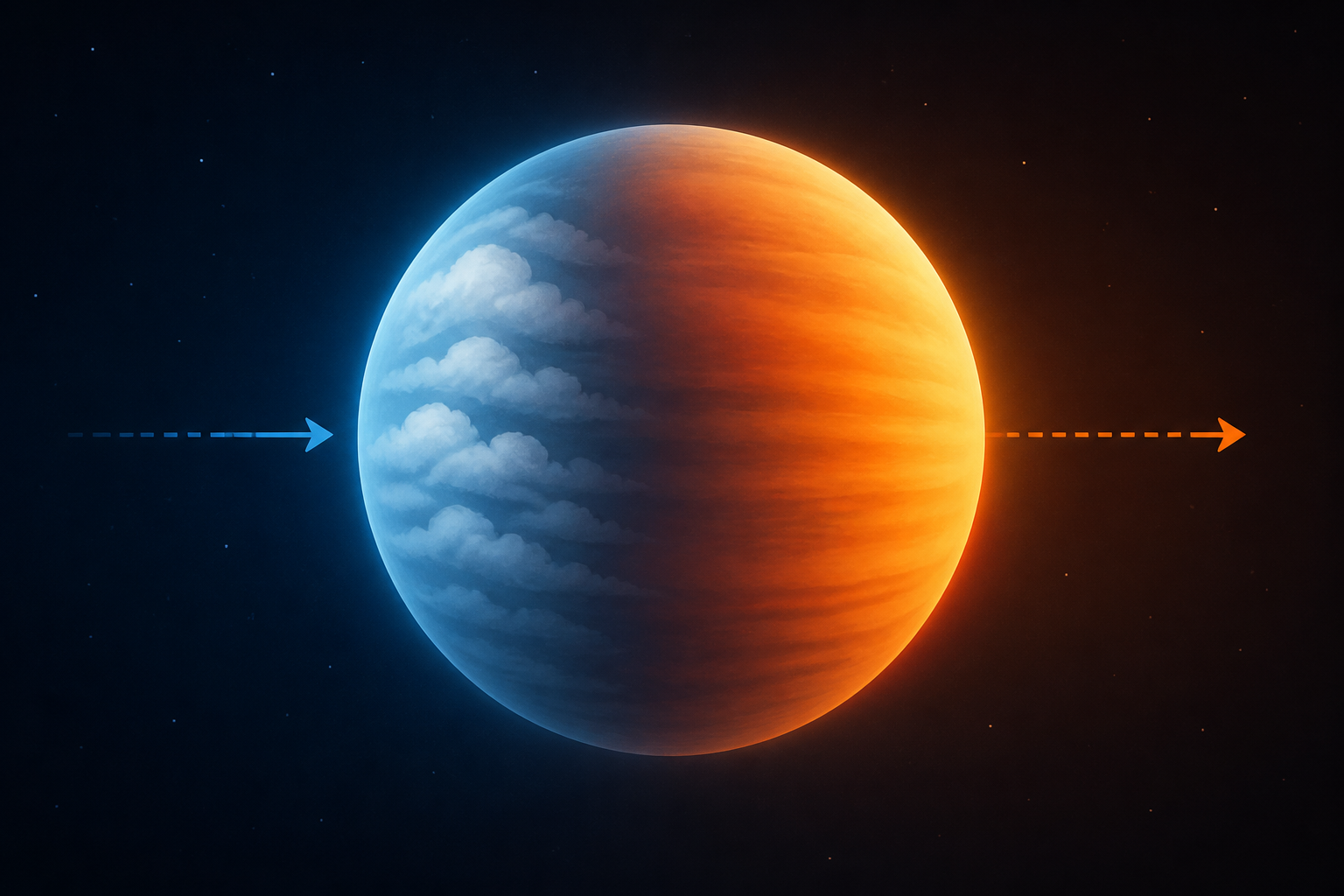
AI Generated Image
A planet nearly 700 light-years away has clouds that form on its cooler morning side and disappear by the time the atmosphere reaches its scorching evening side. James Webb has given astronomers their
Space Daily • • science
Key Points:
- Astronomers used the James Webb Space Telescope's NIRISS instrument to perform limb-resolved spectroscopy of the hot Jupiter WASP-94A b, revealing distinct atmospheric conditions on its morning and evening edges despite the planet being too distant for direct imaging.
- The morning limb is cooler and cloud-covered with mineral (rock-forming) condensate clouds, while the evening limb is hotter, clearer, and shows strong water vapor absorption, indicating a temperature difference of at least 280 kelvin driving cloud formation and evaporation cycles.
- This study demonstrates that treating the planet's atmosphere as uniform can lead to incorrect chemical abundance estimates, as averaging the different limbs obscures the true atmospheric composition and dynamics.
- The findings provide a model of a persistent mineral cloud cycle driven by tidally locked atmospheric circulation, offering new insights into exoplanet weather patterns and improving interpretations of transmission spectra.
- WASP-94A b is becoming a calibration case for studying hot Jupiter atmospheres, with similar limb asymmetries observed on other exoplanets, highlighting the importance of considering three-dimensional atmospheric variations in exoplanet characterization.


