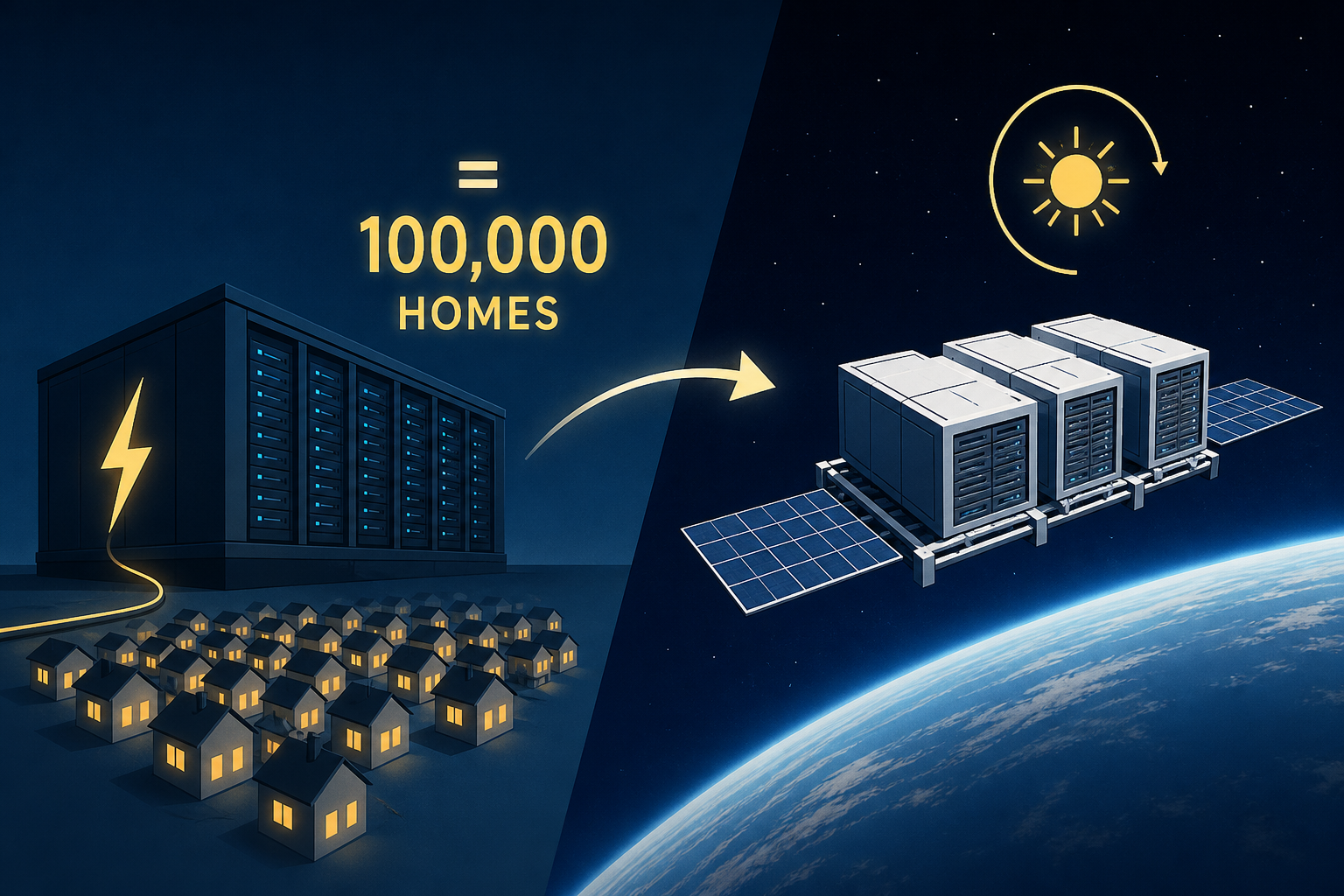
AI Generated Image
A typical AI-focused data centre consumes as much electricity as 100,000 homes; that demand has helped trigger a race to put computing clusters into orbit, where companies argue that near-continuous s
Space Daily • • business
Key Points:
- AI-focused data centres consume enormous amounts of electricity, with some facilities using as much power as 100,000 households, prompting interest in relocating computing infrastructure to orbit to leverage near-continuous solar energy and reduce terrestrial resource constraints.
- Orbital data centres could benefit from consistent sunlight and avoid competition for land, water, and grid resources, but face significant engineering challenges including heat dissipation in vacuum, radiation shielding, launch costs, and hardware reliability in space.
- Launch costs and spacecraft mass are critical factors; current launch prices exceed the threshold for cost-competitive orbital data centres, making the concept viable only if launch costs drop significantly in the coming decade.
- Communication bandwidth between Earth and orbit is a major limitation, as many AI workloads require large data transfers; near-term orbital data centres may focus on processing tasks already in space, such as satellite imagery analysis and delay-tolerant AI applications.
- Rather than replacing terrestrial data centres, orbital data centres are likely to serve as a complementary layer for specialized space-related tasks, addressing energy bottlenecks but introducing new challenges in spacecraft design, maintenance, and orbital debris management.


