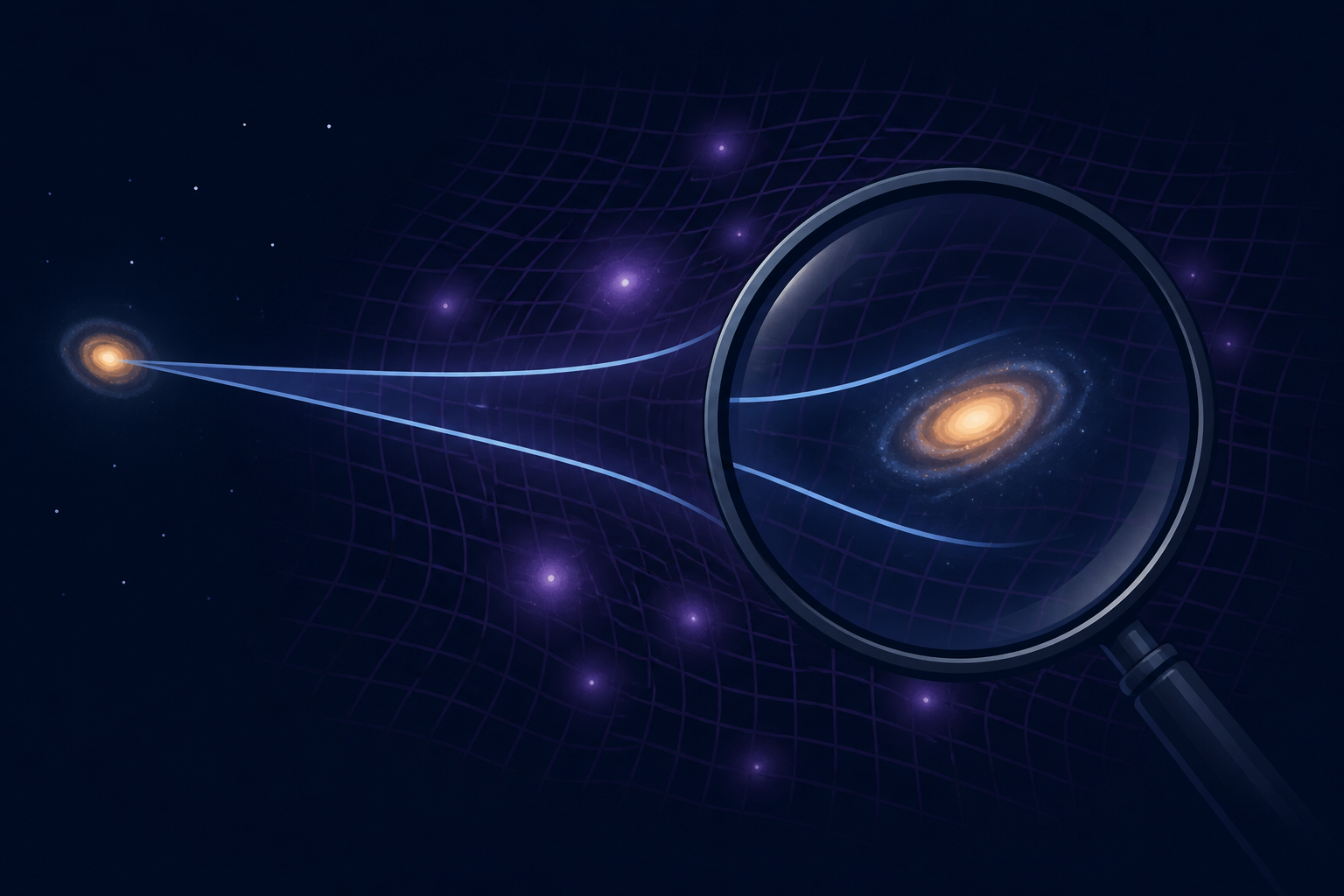
AI Generated Image
Astronomers Realize Dark Matter Has Been Magnifying Cosmic Readings
Yahoo • • science
Key Points:
- Researchers from the Max Planck Institute for Radio Astronomy suggest that neutrino detections at the IceCube Neutrino Observatory may be explained by dark matter gravitational lensing affecting signals from the blazar PKS 2233-148.
- A blazar, a type of quasar with a jet pointed directly at Earth, was observed using multiple telescopes, revealing that its jet's path is sometimes deflected without visible matter causing the disturbance.
- The team proposes that this deflection is due to gravitational lensing by a filament of dark matter, marking a potential first observation of such an effect on emissions from a blazar.
- This gravitational lensing not only magnifies the signals but could also help correlate neutrino detections with blazar activity, offering new insights into the blazar’s supermassive black hole core as a potential neutrino source.
- Understanding these lensing effects may enable astronomers to probe deeper into the mechanisms of blazars and improve interpretations of cosmic particle observations.


