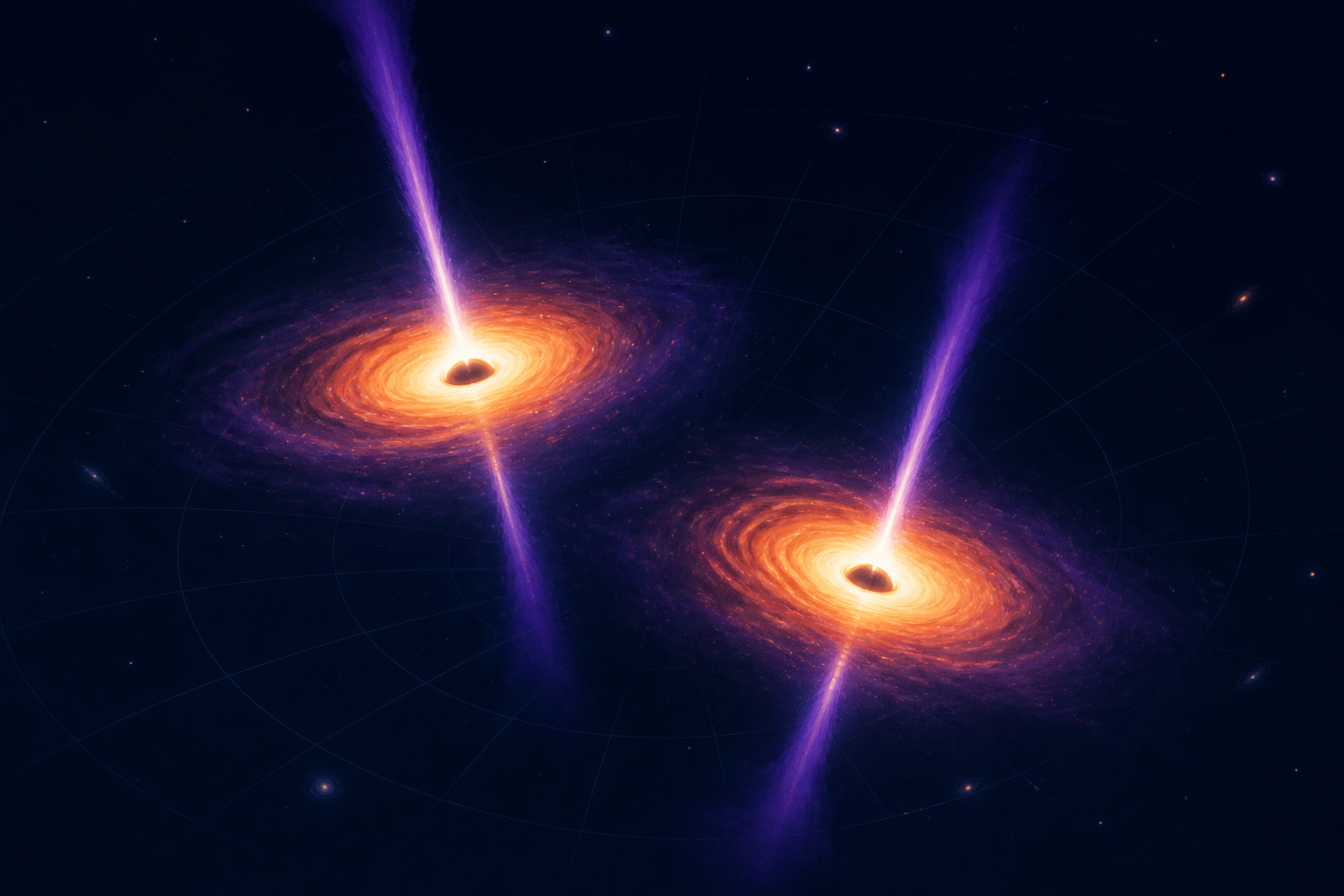
AI Image
Astronomers stunned after James Webb Space Telescope discovers the earliest pair of black hole-powered quasars
Yahoo Tech • • science
Key Points:
- Astronomers using the James Webb Space Telescope (JWST) and Gemini North telescope have discovered Nāpōwawāʻenakaulua, the oldest and most compact pair of supermassive black hole-powered quasars ever observed, dating back to 900 million years after the Big Bang.
- The two black holes in this quasar pair have masses of 1.5 billion and 400 million times that of the sun and are separated by only 18,100 light-years, about one-fifth the diameter of the Milky Way.
- This discovery challenges current models of black hole growth, as such massive black holes were not expected to form so early in the universe’s history, especially in such close proximity.
- The quasar pair was identified through data from JWST's Aether survey, which has found nearly half of all known early universe quasars, with Gemini North providing the critical ground-based observations needed to resolve the pair.
- Nāpōwawāʻenakaulua offers a unique opportunity to study galaxy formation and black hole assembly during Cosmic Dawn, a crucial period shortly after the first stars and galaxies formed.


