AI Image
Astronomers witness star eating its companion for the first time
New York Post • • general
Key Points:
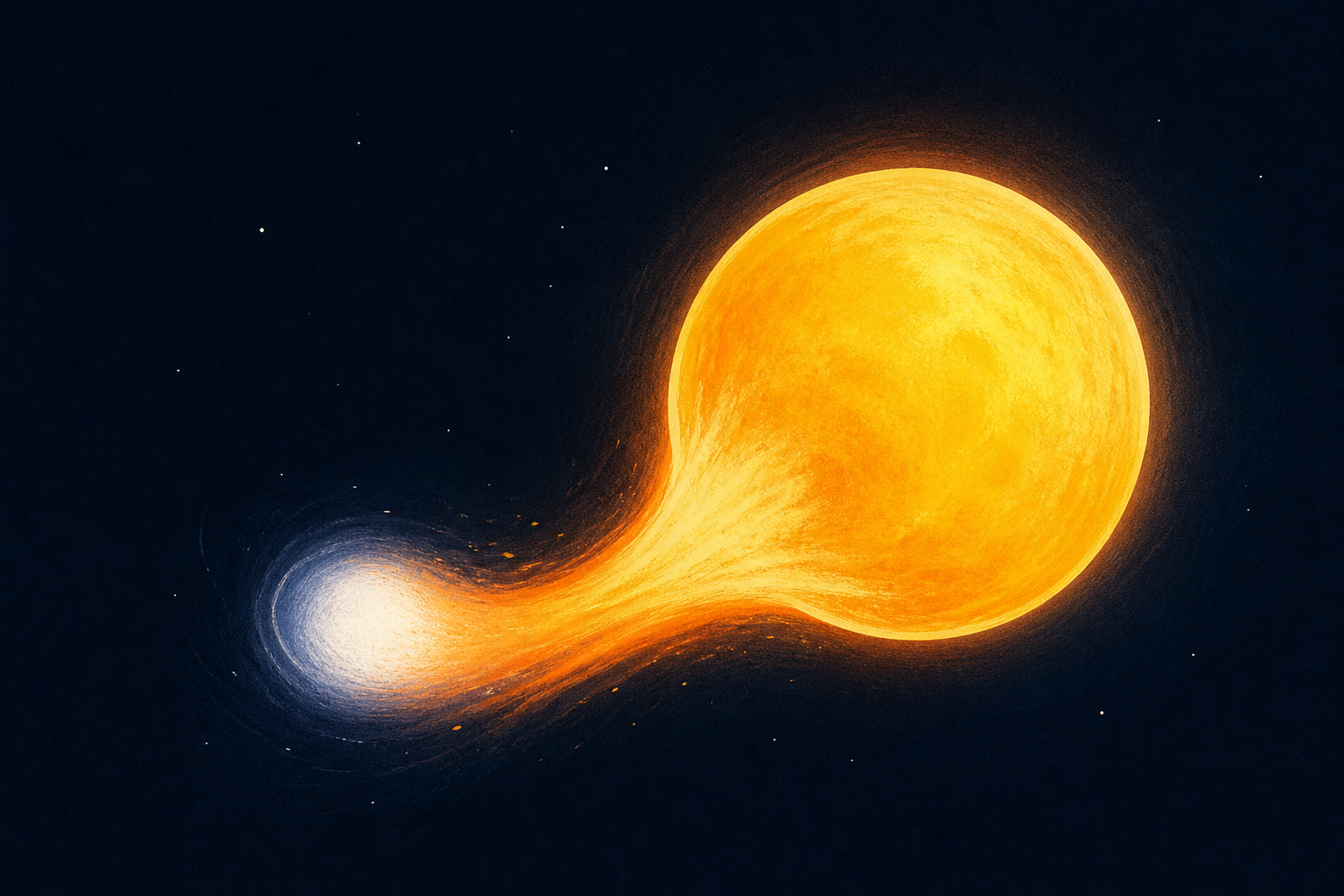
- Astronomers observed for the first time a dying red giant star engulfing its companion star in a binary system, confirming a long-theorized process called common envelope evolution (CEE).
- The event, occurring in the Andromeda galaxy about 2.5 million light-years away, was identified through gradual brightening over seven years, culminating in a giant eruption of light detected in 2023.
- NASA’s James Webb Space Telescope captured the aftermath 47 days post-eruption, supporting the hypothesis that the companion star, about 70% the mass of the Sun, collided with the red giant’s core, expelling material equivalent to 0.1-0.2 solar masses.
- While the merger scenario is favored, researchers acknowledge the alternative that both stars survived in a closer orbit, and ongoing observations will clarify the system’s evolution.
- Scientists anticipate that future telescopes like the Nancy Grace Roman Space Telescope and Vera Rubin Observatory will enable discovery of many more such stellar merger events.


