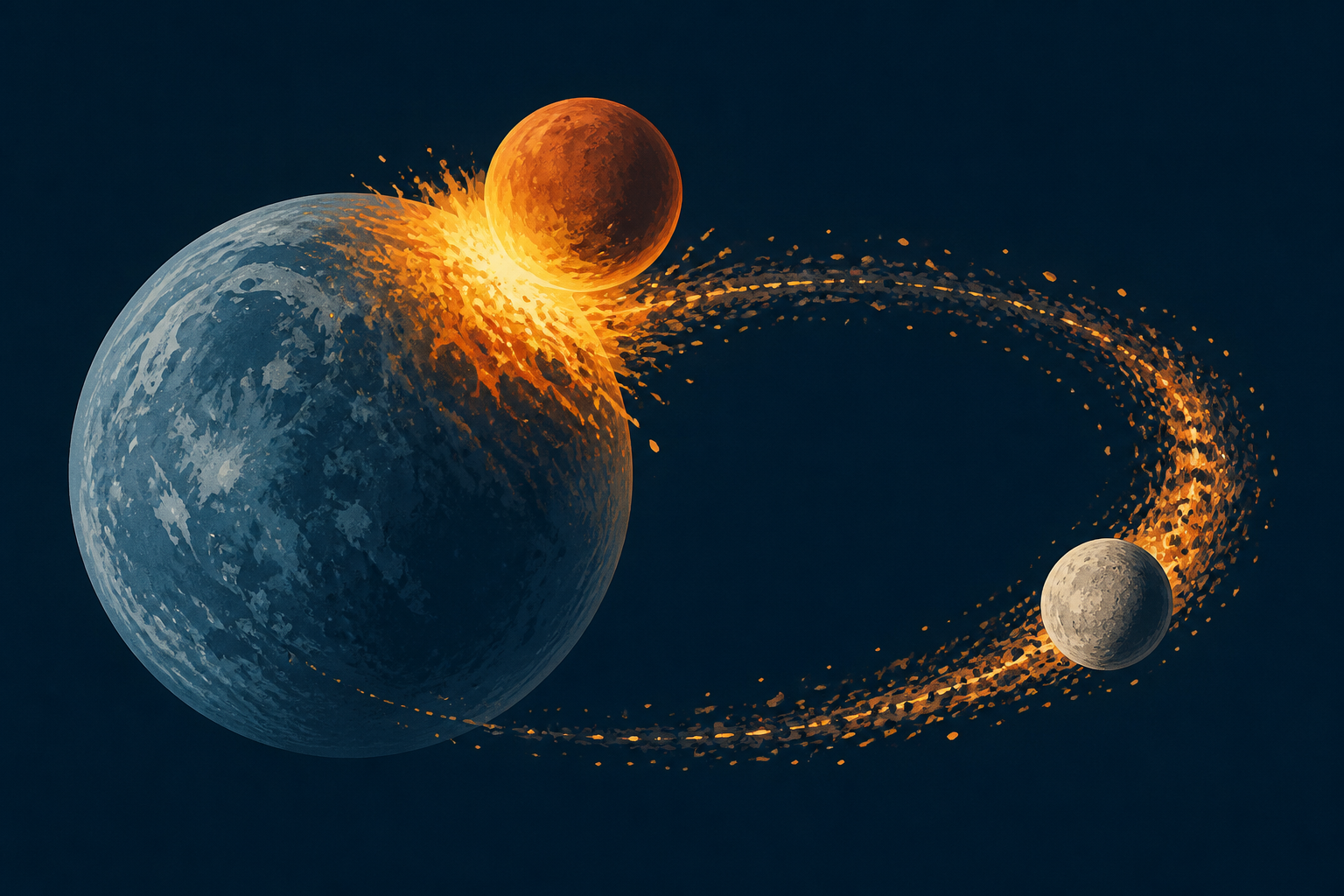
AI Generated Image
At its birth, Earth had no Moon. Then something perhaps the size of Mars slammed into the young planet, flinging molten debris into orbit that became the companion world now pulling our tides, steadyi
Space Daily • • science
Key Points:
- The prevailing theory for the Moon's origin is the giant-impact hypothesis, which posits that a Mars-sized body named Theia collided with the early Earth about 4.5 billion years ago, creating debris that eventually formed the Moon.
- This theory is supported by the chemistry of lunar rocks brought back by Apollo missions, which closely match Earth's composition, although the near-identical oxygen isotope ratios between Earth and Moon pose a challenge to the straightforward impact model.
- The Moon significantly influences Earth through tidal forces and by stabilizing Earth's axial tilt, which helps maintain relatively stable seasons; however, the extent of the Moon's role in enabling complex life remains debated and is considered a hypothesis rather than established fact.
- Future lunar missions, such as NASA's Artemis program, aim to collect new samples from unexplored regions of the Moon to resolve outstanding questions about its precise age, isotopic composition, and the details of its formation.


