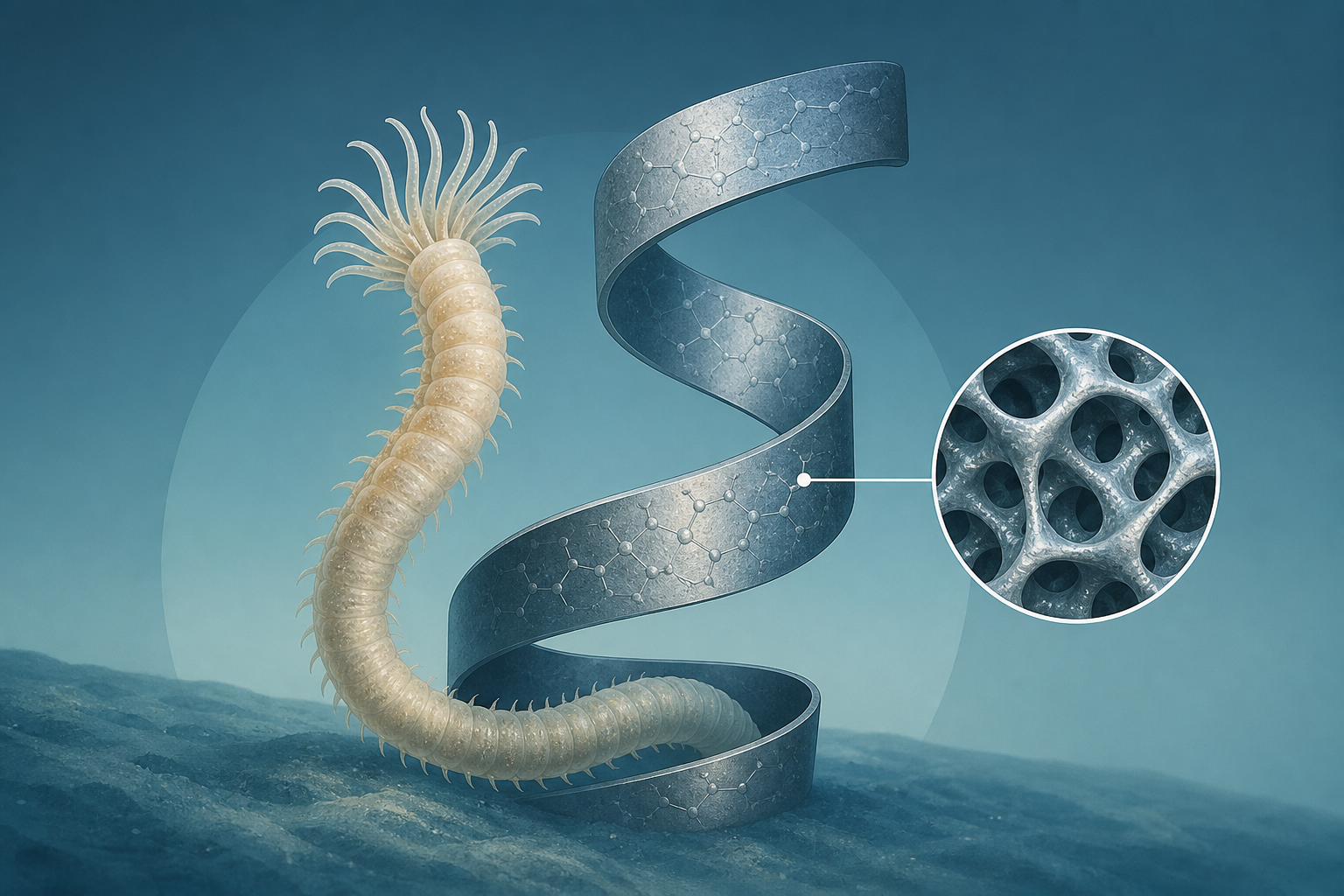
AI Generated Image
Bio-metals: Ancient sea worms hold the secret to a strange new class of materials
Yahoo • • science
Key Points:
- Researchers from TU Wien and the University of Vienna studied the jaws of Perinereis cultrifera, an ancient sea worm, revealing that its biting tools combine protein and metal ions to create hardness and deformation behaviors similar to metals like copper and silver.
- The team identified a new material category called "bio-metals," characterized by hardness, strain behavior, and an ion-protein structure, distinguishing these biological materials from conventional metals and metallike biomaterials.
- Using nanoindentation, the study found that the worm's jaw tips are harder due to higher metal ion concentration and exhibit size-dependent hardness and elasticity patterns consistent with the Nix-Gao effect, a phenomenon typically seen in crystalline metals but arising here from a protein matrix.
- Mathematical modeling suggested that dislocation-like folds in the ion-coordinated protein matrix produce strain gradients affecting elasticity, providing a theoretical basis for the worm jaw's unique mechanical properties and supporting the bio-metal classification.
- The researchers plan to expand their study to other bristle worm species and explore genetic influences on jaw composition and mechanics, aiming to deepen understanding of bio-metal materials and their potential applications in biophysics and bioengineering.


