AI Image
Cape Cod meteor in May 2026 was likely lone wolf from Jupiter
The Boston Globe • • general
Key Points:
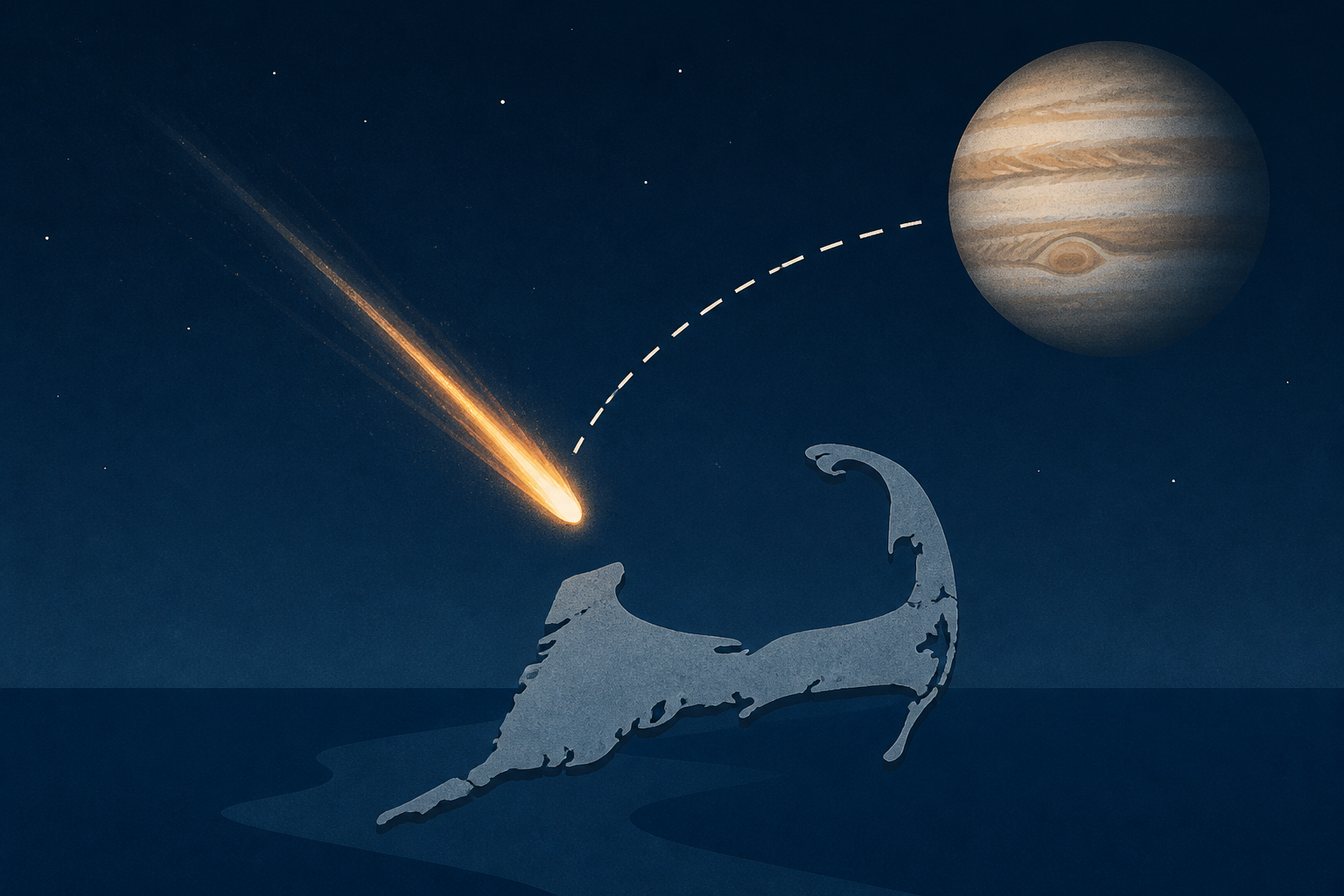
- On May 30, a spectacular "superbolide" meteor, about 5 feet wide and weighing roughly 12,000 pounds, entered Earth's atmosphere over Massachusetts, creating a sonic boom and lighting up the sky.
- Scientists used a combination of meteor radar, weather radar, satellite data, and atmospheric pressure sensors to reconstruct the meteor's trajectory, revealing it originated from the main asteroid belt near Jupiter’s orbit, roughly four times Earth's distance from the Sun.
- The meteor traveled at nearly 58,000 miles per hour and released energy estimated between 0.5 and 1.1 kilotons of TNT equivalent as it burned in the atmosphere, causing shock waves detected across New England.
- The meteor was unusually dense and likely iron-rich, with fragments possibly surviving the atmospheric entry and landing in Cape Cod Bay, within an estimated 1.9-by-2.3-mile area, at depths up to 200 feet.
- This rare event provided valuable scientific insights and may be a once-in-a-lifetime occurrence for the region.


