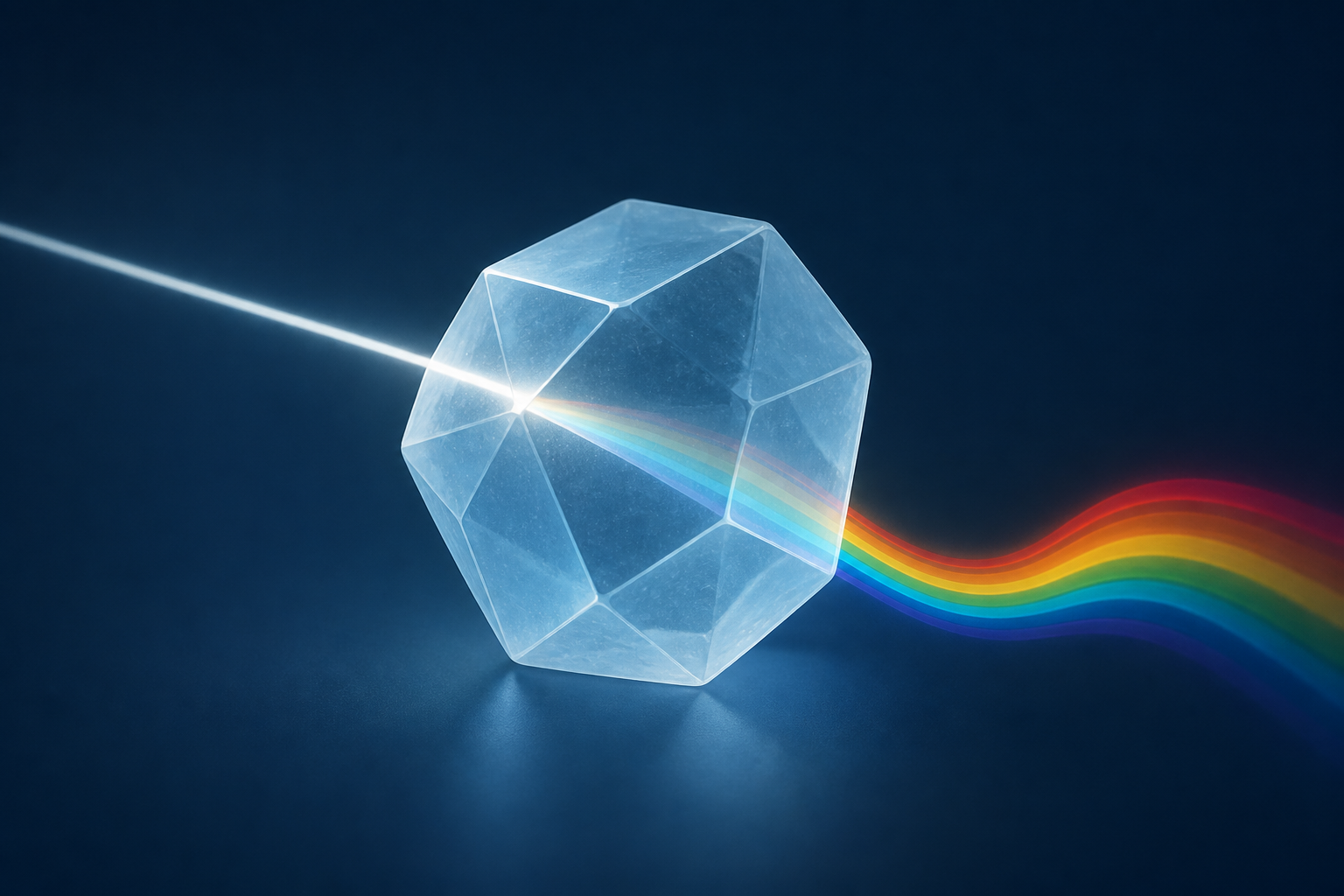
AI Generated Image
Crystal made from 13-sided 'einstein' shape bends light in ways nobody imagined
Yahoo • • science
Key Points:
- Physicists have created a photonic crystal using the "einstein" tile, a unique 13-sided shape that never repeats its pattern, solving a decades-old mathematical puzzle known as the "einstein problem."
- The crystal, made by etching nanoscale holes in silicon nitride, bends light to produce an asymmetrical, pinwheel-shaped scattering pattern that varies depending on the circular polarization direction of the incoming light.
- This chirality effect, caused by the tile's lack of mirror symmetry, is a novel property not found in ordinary quasicrystals and could lead to new ways to control light in photonic devices.
- The research team envisions applying this never-repeating pattern to guide light within photonic chips, potentially advancing optical communications and computing technologies that use light instead of electricity.


