Deforestation-induced drying lowers Amazon climate threshold
Nature • • world
Key Points:
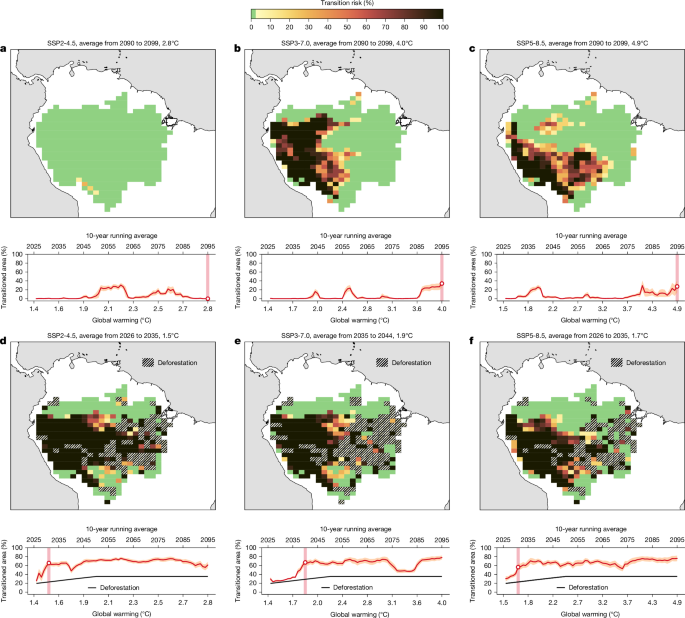
- The Amazon forest is increasingly threatened by anthropogenic activities such as deforestation and drought, which undermine its atmospheric moisture recycling and self-stabilizing mechanisms, potentially triggering critical transitions to degraded states at global warming levels between 3.7 and 4.0 °C without deforestation, and at even lower warming (1.5–1.9 °C) with severe deforestation.
- Trees contribute significantly to atmospheric moisture recycling, with up to 50% of the Amazon’s precipitation being forest-generated; deforestation and drought reduce this recycling, delaying wet seasons and increasing forest vulnerability, especially in western and southwestern regions.
- Using a novel Lagrangian moisture tracking model (UTrack) driven by NorESM2 Earth system model outputs and Shared Socioeconomic Pathways (SSPs), the study quantifies Amazon forest resilience and tipping risks, incorporating local adaptive capacities, moisture transport networks, and deforestation scenarios.
- The research finds that widespread Amazon forest transitions could affect up to 35% of the basin under high warming without deforestation, and up to 77% with severe deforestation, highlighting the crucial role of limiting deforestation alongside global emission reductions to prevent irreversible ecosystem shifts.
- Extensive robustness checks confirm the results' stability despite uncertainties in evapotranspiration, adaptation capacities, and model assumptions; the study emphasizes the potential of forest restoration to enhance resilience and calls for global cooperation to halt emissions, end deforestation, and restore forest cover.


