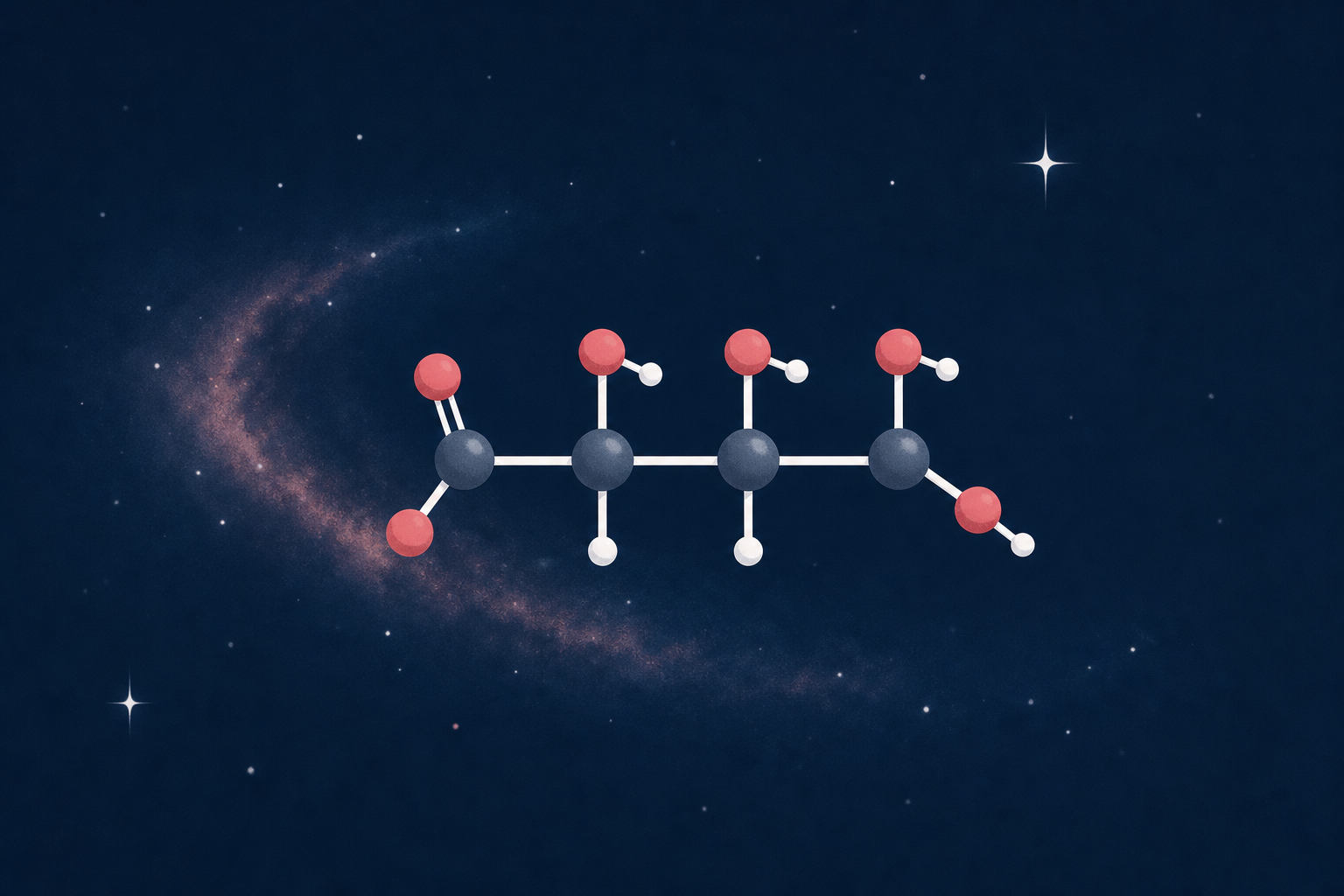
AI Generated Image
Detection of a four-carbon sugar in interstellar space
Nature • • general
Key Points:
- Researchers have detected erythrulose, a C4 ketose sugar and chiral molecule, in the Galactic Centre molecular cloud G+0.693 using ultrasensitive spectral surveys with the Yebes 40 m and IRAM 30 m telescopes, identifying multiple unblended spectral transitions consistent with its predicted spectrum.
- The analysis yields an excitation temperature of approximately 11.3 K and a column density translating to an erythrulose abundance of about 6.4 × 10⁻¹⁰ relative to H₂, making it more abundant than C3 sugars like glyceraldehyde and dihydroxyacetone, which were not detected.
- Laboratory and computational studies suggest erythrulose forms on interstellar ice surfaces via radical-radical reactions between glycolaldehyde and ethylene glycol, with astrochemical modeling supporting efficient formation under Galactic Centre conditions and cosmic-ray ionization rates typical of this environment.
- The detection of erythrulose, the largest non-cyclic molecule and first sugar with four oxygen atoms found in the interstellar medium, provides evidence that complex, chiral organic molecules can form abiotically in space, potentially contributing prebiotic material to early Earth and other planetary systems.
- This discovery supports the hypothesis that interstellar chemistry could supply sugar feedstock for the prebiotic synthesis of nucleic acids, linking the molecular complexity observed in space with organic compounds found in meteorites and minor Solar System bodies.


