Entanglement and electronic coherence in attosecond molecular photoionization
Nature • • science
Key Points:
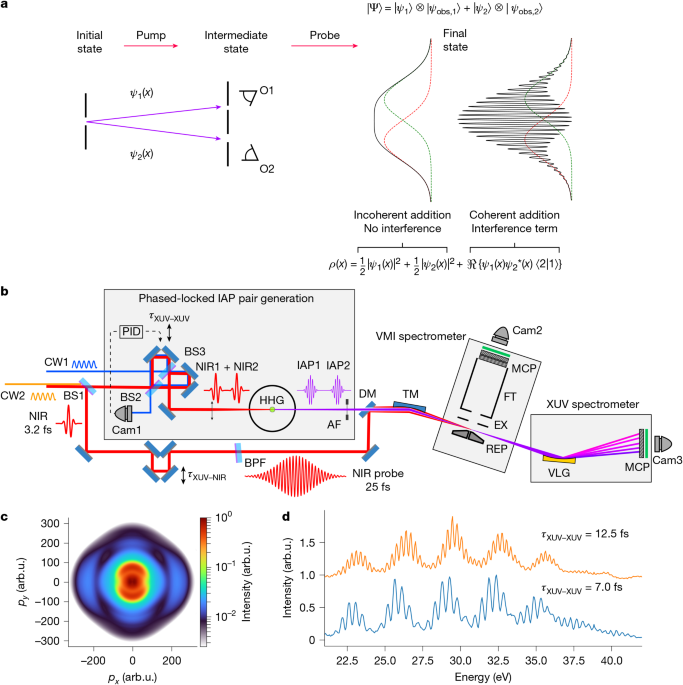
- The study investigates ion–photoelectron entanglement and electronic coherence in H2 molecules ionized by phase-locked pairs of isolated attosecond pulses (IAPs) combined with near-infrared (NIR) pulses, revealing how photoelectron kinetic energy and orbital angular momentum control these quantum effects.
- Experiments measure asymmetries in H+ fragment ejection as a signature of electronic coherence in the H2+ ion, showing oscillatory behavior dependent on the delay between IAPs (τXUV–XUV) and between the IAP pair and NIR pulse (τXUV–NIR), with coherence maximized when τXUV–XUV is an integer multiple of the NIR optical period.
- Theoretical modeling using full-dimensional time-dependent Schrödinger equation simulations confirms the experimental findings and demonstrates an anticorrelation between electronic coherence and ion–photoelectron entanglement quantified via von Neumann entropy, indicating entanglement limits observable coherence.
- The NIR pulse plays a critical role by enabling transitions between ionic electronic states and altering photoelectron angular momentum, which can create or suppress electronic coherence depending on the timing of the pulses and energy matching conditions.
- This work highlights the fundamental role of quantum entanglement in attosecond molecular dynamics and suggests that controlling entanglement via pulse timing could enable new approaches to manipulate ultrafast charge migration and develop multidimensional XUV spectroscopy techniques.


