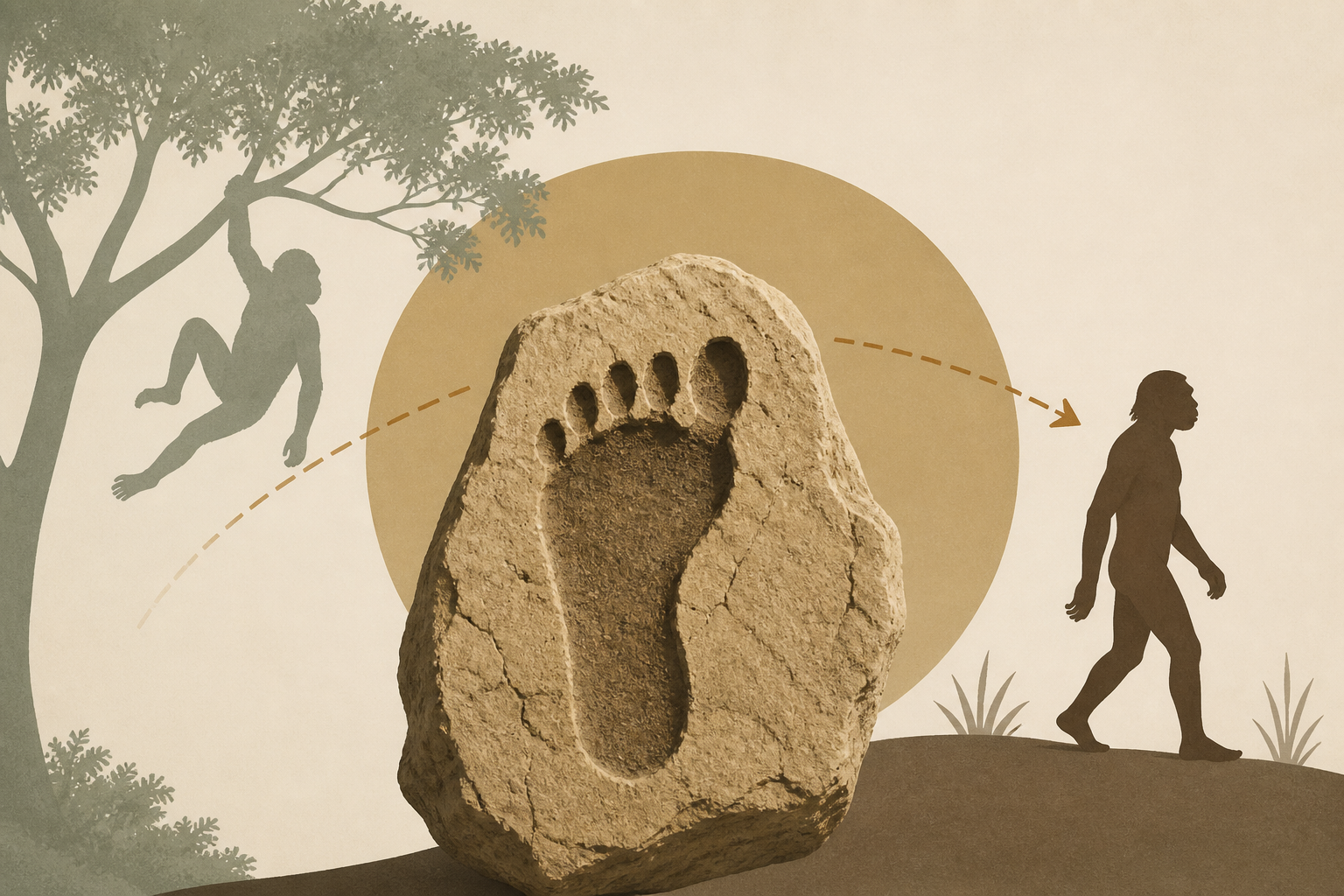
AI Generated Image
Fossil Evidence Suggests Early Homo Had Abandoned Tree-Climbing by 1.8 Million Years Ago
Sci.News • • science
Key Points:
- New research analyzing limb bone strength in fossil skeletons reveals when our ancestors transitioned from frequent tree climbing to habitual bipedal walking, a key debate in human evolution.
- The study found that the 3.67-million-year-old Australopithecus fossil "Little Foot" showed a mixed locomotor pattern, with ape-like arm strength indicating arboreal activity alongside human-like lower leg strength suggesting some terrestrial walking.
- In contrast, a 1.8-million-year-old early Homo individual from Dmanisi exhibited limb strength proportions consistent with modern humans, indicating a full commitment to terrestrial bipedalism by that time.
- This shift to habitual bipedalism likely relates to changes in foraging and ranging behaviors rather than tool use, which predates the shift by over a million years.
- The timing of this locomotor transition coincides with increases in brain size, suggesting a possible but not causal relationship, and prompting further investigation into how these evolutionary changes interrelate.


