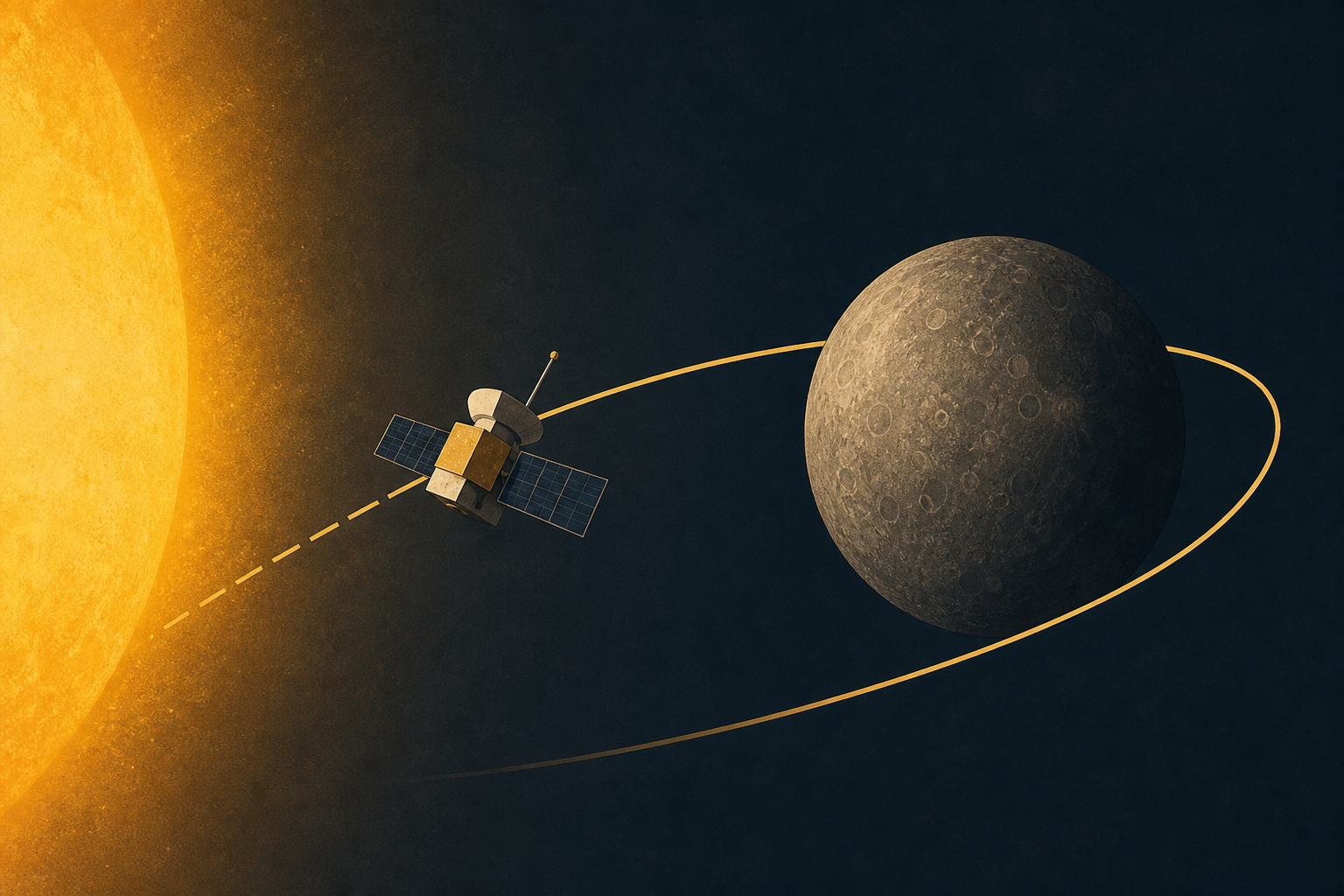
AI Generated Image
In November, a spacecraft that has spent eight years falling toward the Sun will finally settle into orbit around Mercury, a planet we have seen up close fewer times than almost any other in the solar
Space Daily • • science
Key Points:
- BepiColombo, a joint European-Japanese mission launched in 2018, will enter Mercury's orbit in November 2026 after nearly eight years of slowing down through multiple planetary flybys to reduce its speed for capture by Mercury’s gravity.
- The spacecraft consists of a transfer module and two orbiters—the European Mercury Planetary Orbiter and Japan’s Mio orbiter—that will study Mercury’s surface, interior, and magnetic environment simultaneously for the first time.
- A technical issue with the thrusters in April 2024 delayed arrival by about eleven months, requiring a revised trajectory with closer flybys to compensate for reduced thrust while preserving the mission’s scientific objectives.
- Mercury is a challenging and understudied planet with a disproportionately large iron core, a global magnetic field, and water ice in permanently shadowed craters, making BepiColombo’s detailed study vital for understanding its unique characteristics.
- The mission’s critical phases to watch include the gradual orbit insertion in November 2026, the separation of the two orbiters, and the start of scientific operations in 2027, which will address longstanding questions about Mercury’s composition and magnetic field.


