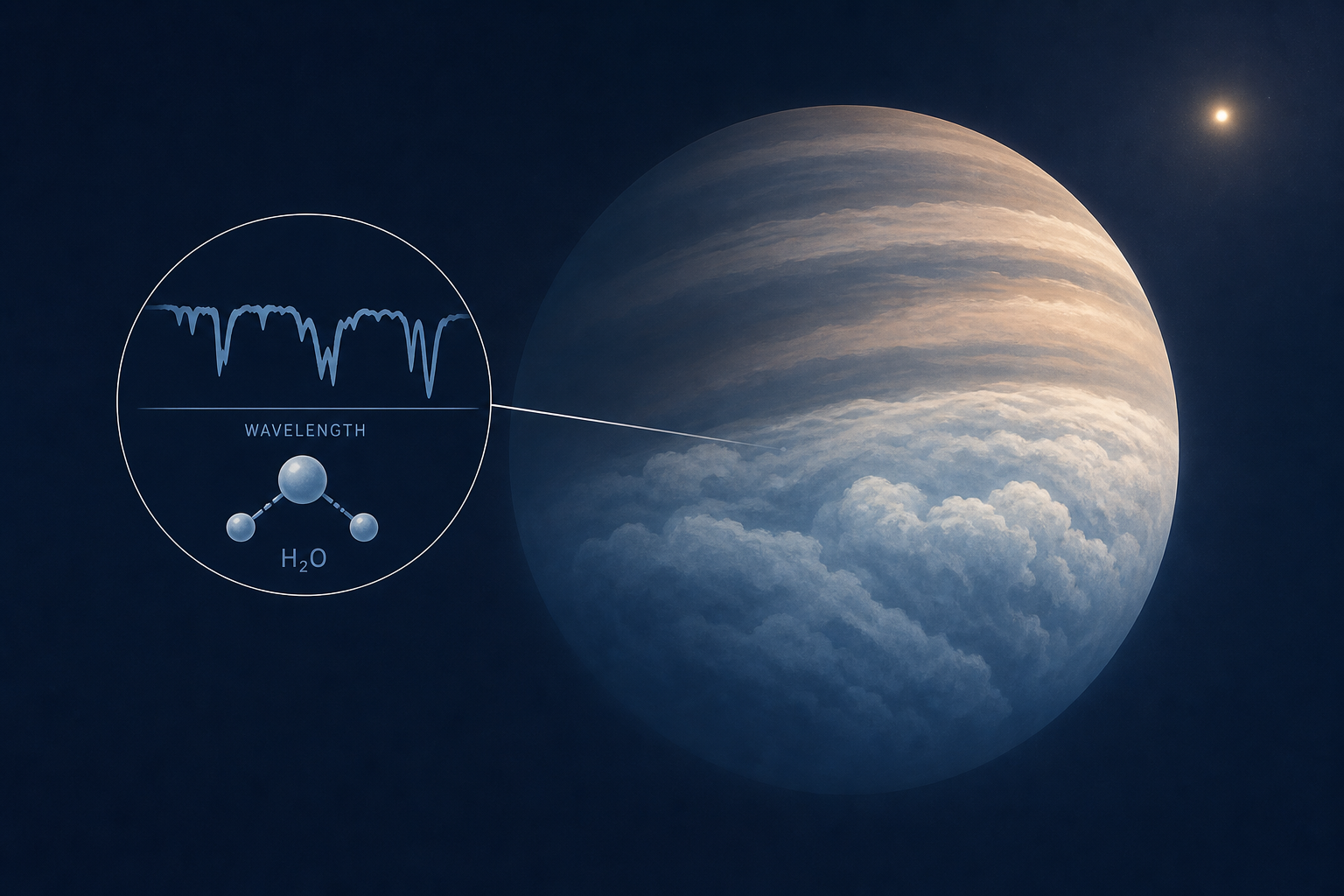
AI Generated Image
James Webb has found evidence for thick water-ice clouds on Epsilon Indi Ab, one of the closest Jupiter-like worlds we can study directly — a discovery that didn’t overturn every atmospheric model, bu
Space Daily • • science
Key Points:
- The James Webb Space Telescope detected evidence of thick water-ice clouds high in the atmosphere of Epsilon Indi Ab, a nearby cold super-Jupiter about 12 light-years away, by noting a missing ammonia signature in its infrared spectrum.
- These water-ice clouds, inferred rather than directly observed, explain the ammonia deficit as they sit above and obscure the ammonia in the planet’s upper atmosphere, highlighting a key atmospheric feature previously omitted in many giant-planet models.
- The discovery reveals that many atmospheric models simplify calculations by excluding clouds, which can significantly alter observed spectra and lead to inaccurate interpretations of planetary atmospheres.
- Epsilon Indi Ab serves as a valuable benchmark for refining atmospheric models, emphasizing the importance of including cloud physics to better understand and interpret the atmospheres of cold giant exoplanets and potentially smaller, more distant worlds.
- Future work involves confirming the presence and distribution of these clouds through additional Webb observations, integrating cloud physics into models, and investigating whether similar ammonia shortfalls and water-ice clouds exist on other cold giant planets.


