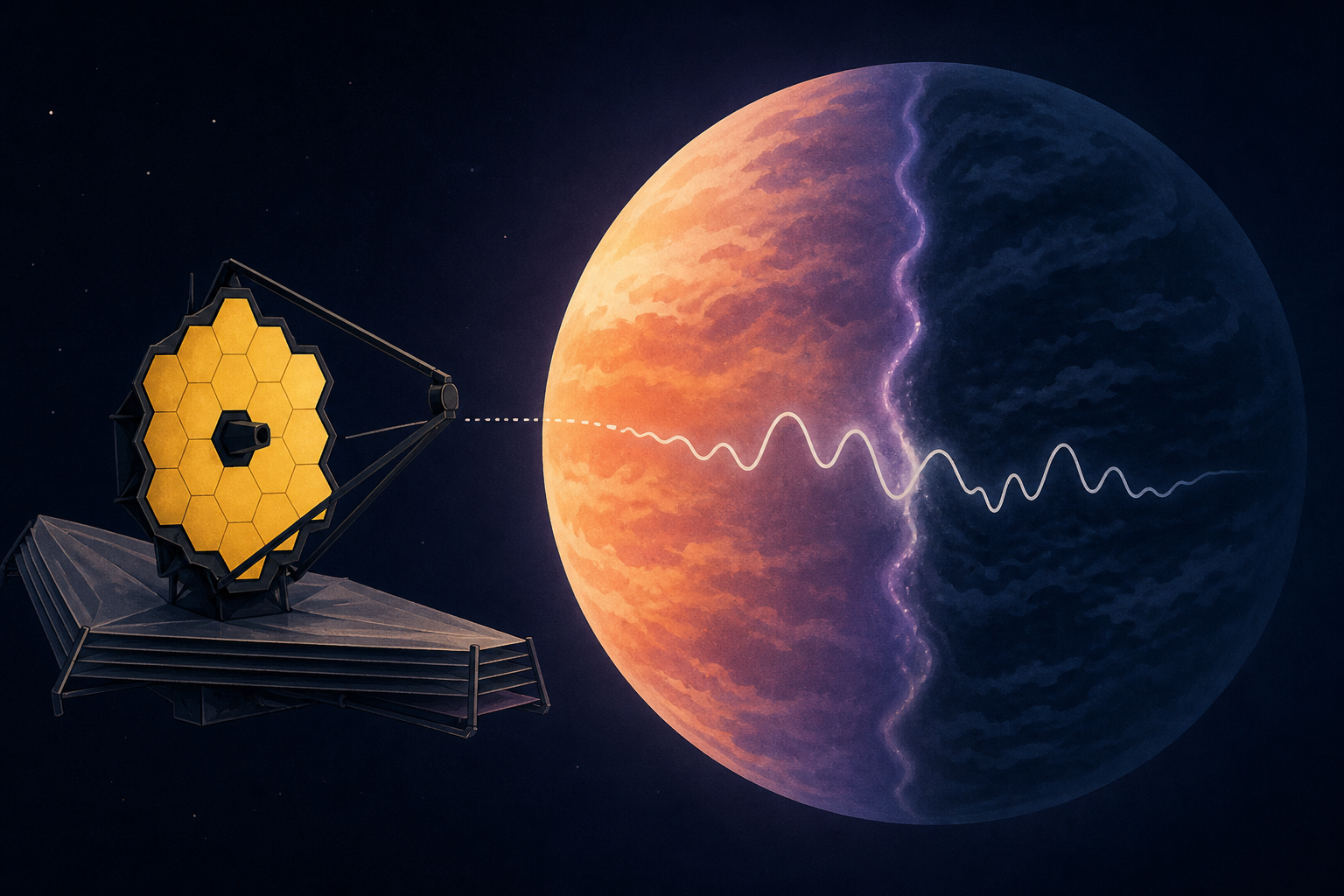
AI Generated Image
James Webb Spots Something Strange Between Day and Night on an Alien Planet
SciTechDaily • • science
Key Points:
- Astronomers using the James Webb Space Telescope (JWST) have detected significant atmospheric differences between the morning (dawn) and evening (dusk) terminators of the ultra-hot gas giant exoplanet WASP-121 b, providing direct observational evidence of predicted asymmetries in temperature and chemistry.
- The evening terminator absorbs more infrared starlight than the morning side due to powerful eastward winds transporting heat from the hot dayside, causing atmospheric expansion and increased absorption; meanwhile, water molecules decrease on the hotter evening side as they break apart from intense heating.
- WASP-121 b is tidally locked, with a permanent dayside averaging around 2770 K (about 2500°C) and a nightside near 1000 K (about 725°C), allowing astronomers to observe atmospheric changes longitudinally as the planet rotates slightly during transit.
- Atmospheric models incorporating temperature variations and potential mineral clouds, such as silicates, help explain observed asymmetries, though more advanced modeling is needed to confirm cloud presence and fully understand cooling effects on the morning terminator.
- This study opens a new method for detailed atmospheric characterization of ultra-hot gas giants, with plans to apply the technique to additional exoplanets to explore common atmospheric patterns and improve understanding of extreme planetary environments.


