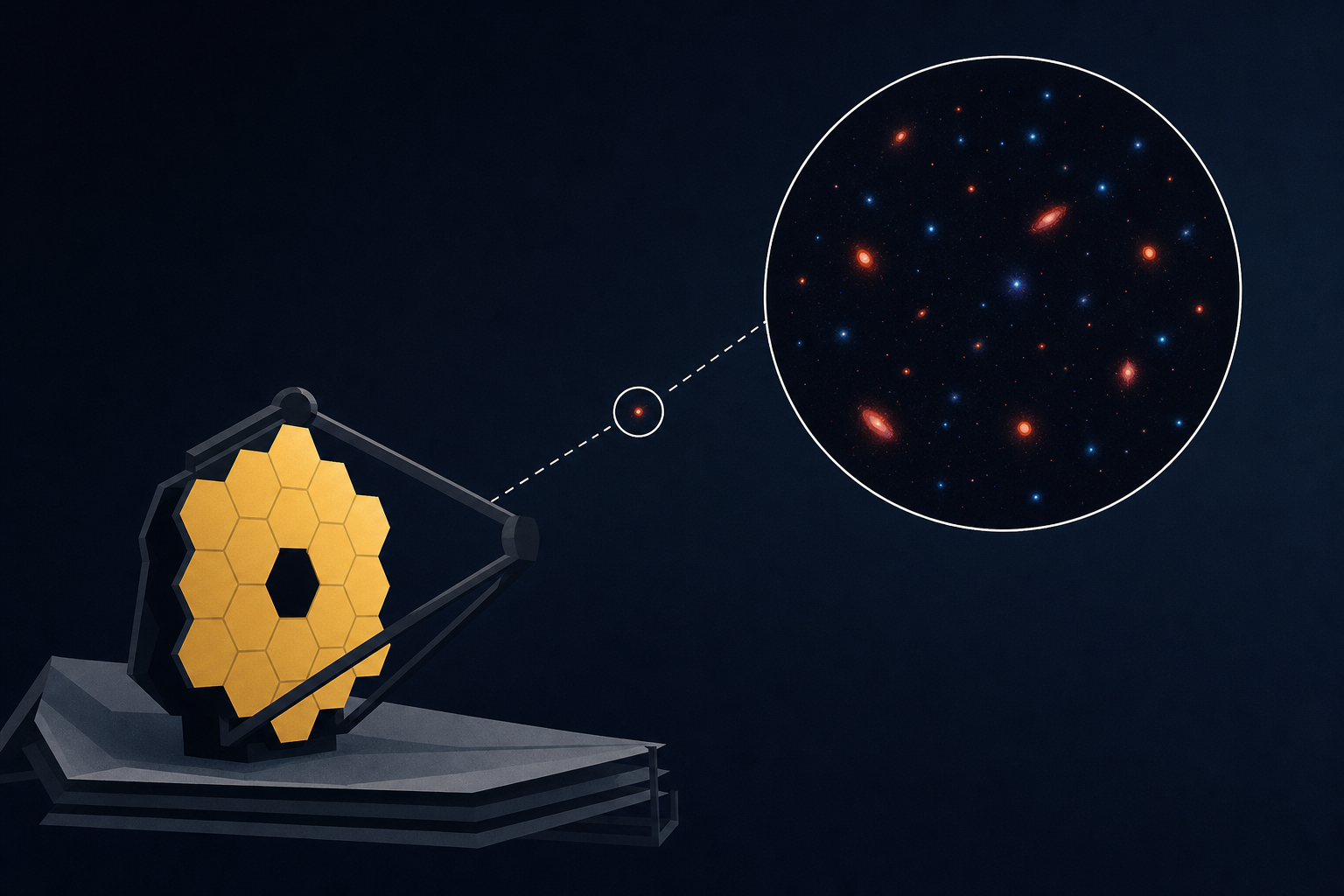
AI Generated Image
James Webb telescope hones in on origin of 'little red dots' at the beginning of time, thanks to their 'little blue companions'
Live Science • • general
Key Points:
- Astronomers using the James Webb Space Telescope (JWST) have proposed that mysterious little red dots (LRDs), compact and brilliant celestial objects from the early universe, may form due to intense ultraviolet (UV) radiation from nearby, previously undiscovered companions.
- The study, published in The Astrophysical Journal Letters, found that many LRDs have blue UV-bright companions—likely star clusters or small early galaxies—whose radiation prevents gas cloud fragmentation, causing the formation of supermassive stars that collapse directly into black holes.
- This new model explains LRDs' unique light signatures, with red optical light from the LRD, UV light from the companion, and a dip caused by hydrogen gas absorption, suggesting that all LRDs may have such companions that are sometimes too close to distinguish.
- The black holes formed through this mechanism could serve as the seeds for the ancient supermassive black holes observed in the early universe, and the merging of LRDs with their UV companions may have contributed to the formation of massive galaxies like the Milky Way.
- While the exact evolutionary fate of LRDs remains uncertain, this discovery offers fresh insights into early cosmic structures and the origins of supermassive black holes and large galaxies.


