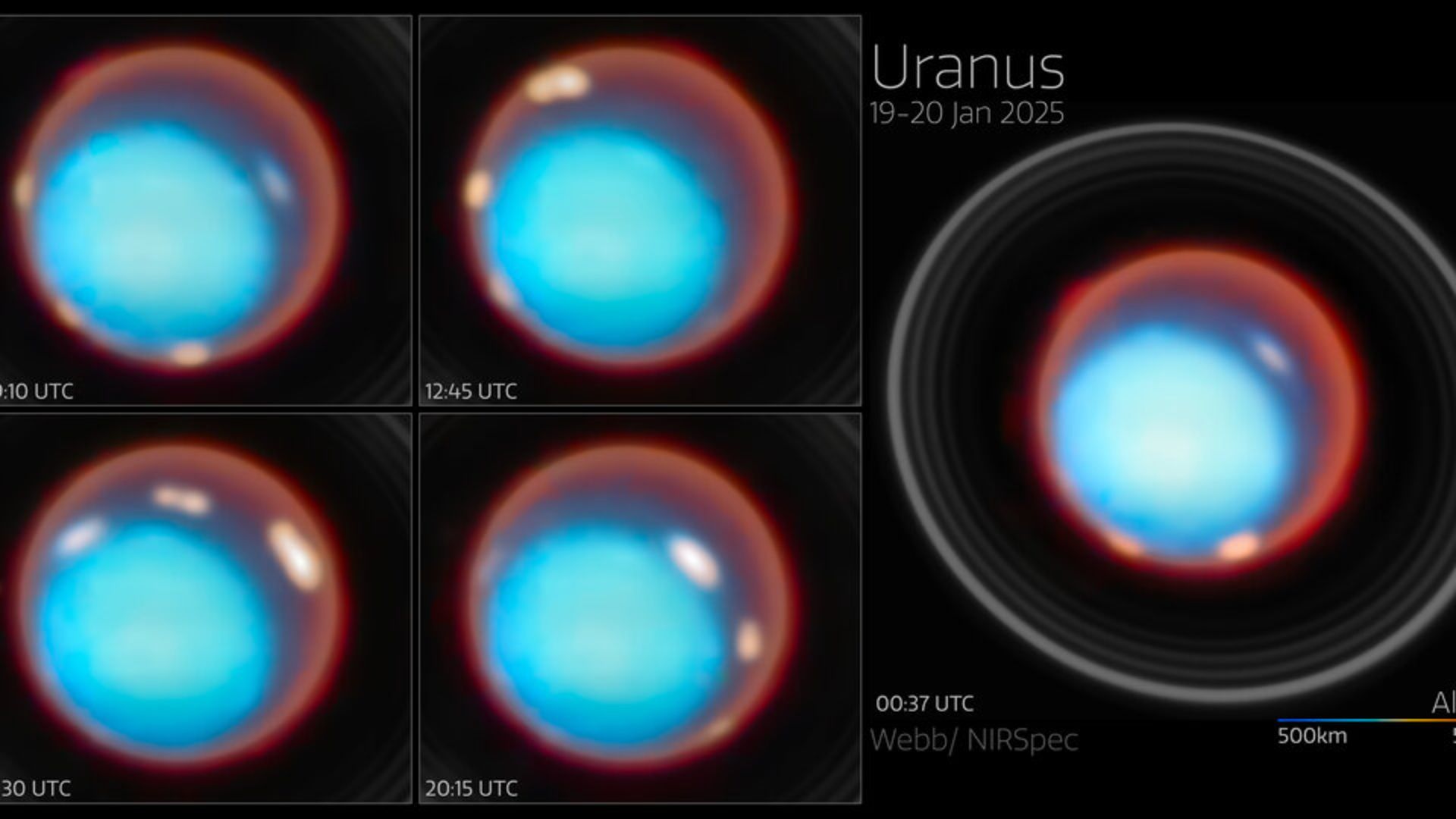
James Webb telescope spots giant auroras rolling through Uranus' atmosphere
Live Science • • general
Key Points:
- The James Webb Space Telescope (JWST) has mapped Uranus' upper atmosphere for the first time, revealing new details about its unique magnetic field and auroras that extend far beyond the planet's poles due to a 60-degree tilt of its magnetic axis.
- JWST observed Uranus for nearly a full rotation (15 hours) to study how energy is distributed in the planet’s upper atmosphere and how auroras operate, producing the most detailed 3D portrait of ion temperature and density up to 3,100 miles above the cloud tops.
- The study found that ion temperature peaks at higher altitudes (2,500-3,100 miles) while ion density is highest closer to the planet (around 600 miles), a pattern


