AI Generated Image
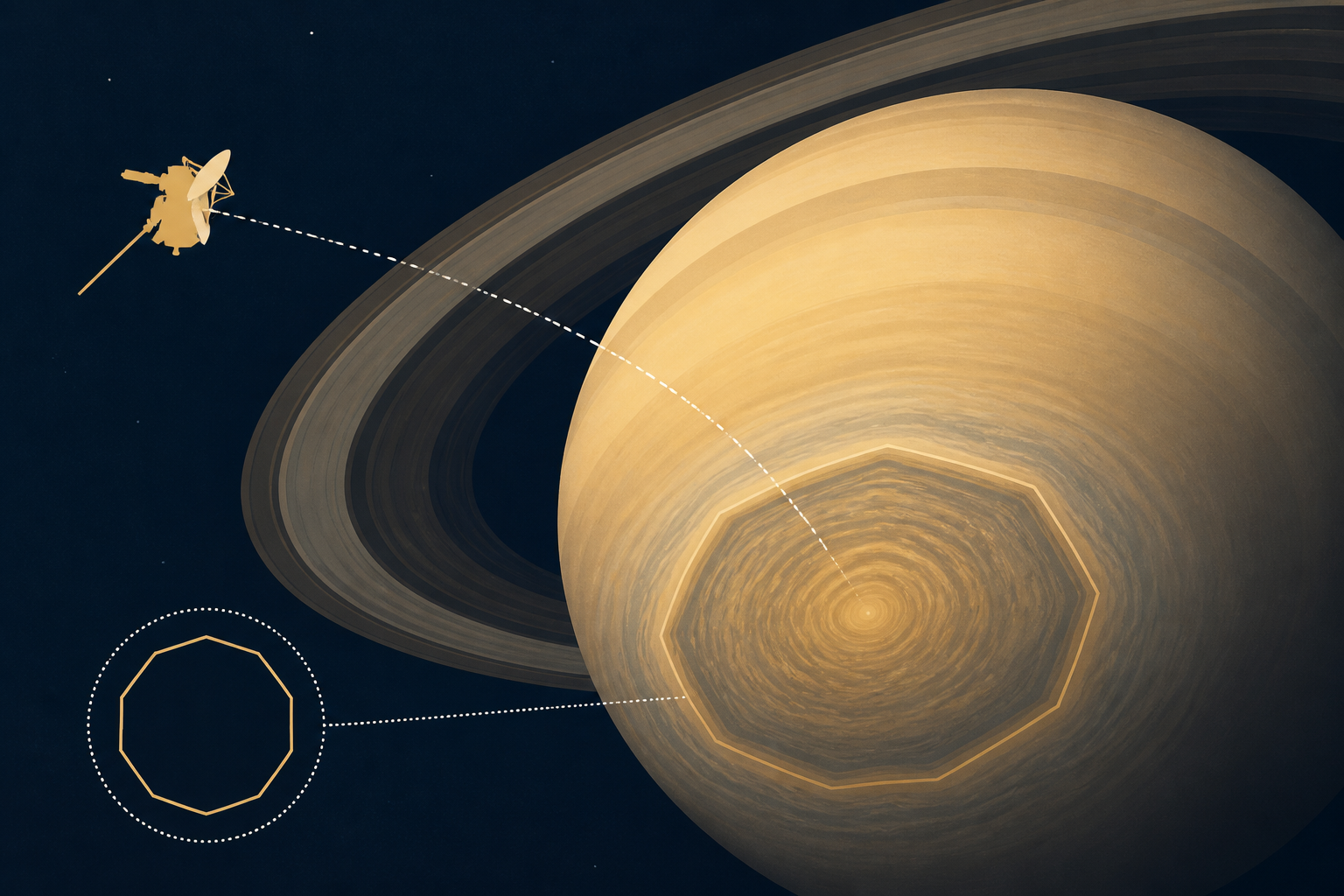
NASA's Cassini spacecraft circled Saturn for 13 years and never saw a shape at the south pole, but when the planet's slow seasons tilted that pole back toward Earth, a giant ten-sided figure was waiti
Space Daily • • science
Key Points:
- NASA and an international team have confirmed the presence of a decagon, a ten-sided atmospheric wave, around Saturn’s south pole, marking the first large geometric jet pattern found in the planet’s southern hemisphere.
- Saturn’s north pole has long been known for its stable hexagon-shaped jet stream, observed for over 40 years, but the south pole previously showed only circular bands during the Cassini mission’s 13-year study.
- The decagon appeared recently, first noticed in 2023, coinciding with Saturn’s 29.5-year orbit and seasonal changes that brought the south pole back into view from Earth.
- Unlike the stationary and stable northern hexagon, the southern decagon is a younger, evolving structure that drifts eastward and appears linked to a nearby large anticyclone called the Red Spot.
- Cassini’s lack of detection of the decagon during its mission provides key evidence that the polygon formed after 2017, highlighting the importance of continued Earth-based observations to understand its future development.


