AI Generated Image
Physicists take Hall effect in a new direction
phys.org • • general
Key Points:
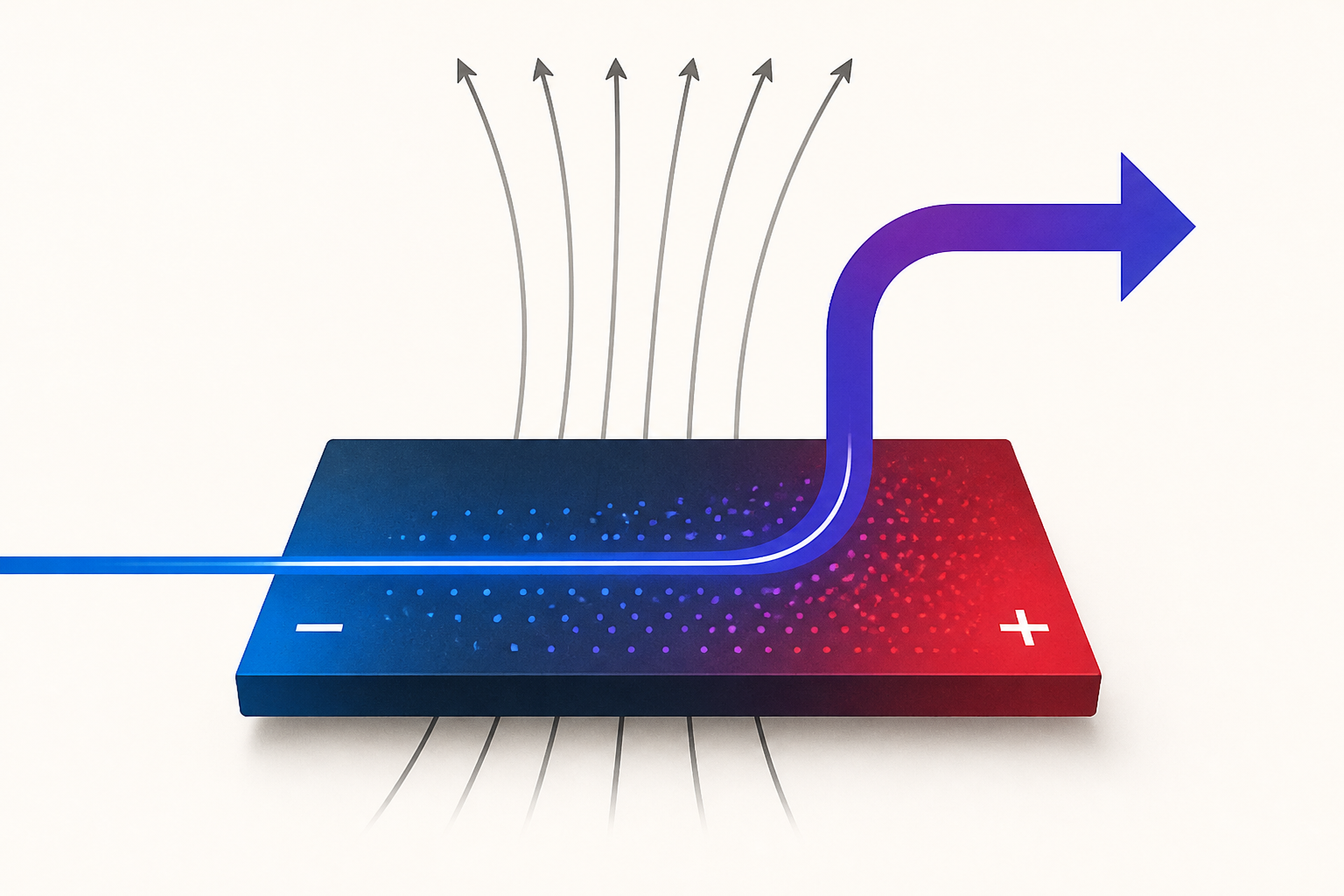
- Carnegie Mellon University scientists have experimentally demonstrated a new form of the Hall effect, showing that a magnetic field applied in-plane (rather than only perpendicular) can produce a measurable Hall response, challenging a century-old assumption.
- This discovery expands the Hall effect's role in physics by enabling magnetization-dependent signals in multiple directions, allowing for multidimensional magnetic sensing and novel device architectures such as vector magnetometry within a single ultrathin sensor.
- The team fabricated nanometer-scale heterostructures combining tantalum iridium telluride (TaIrTe4) with a magnetic layer (Cr2Ge2Te6), leveraging atomic precision to induce magnetism in the nonmagnetic layer and observe both conventional and unconventional Hall signals.
- Theoretical modeling revealed that reduced symmetry and enhanced spin-orbit coupling at the interface are key to the in-plane anomalous Hall effect, with ongoing research aimed at fully characterizing the mechanism and exploring room-temperature operation for practical applications.
- This breakthrough could lead to simpler, more versatile magnetic sensing technologies used across electronics, transportation, and medical imaging, broadening the fundamental understanding and technological utility of the Hall effect.


