AI Generated Image
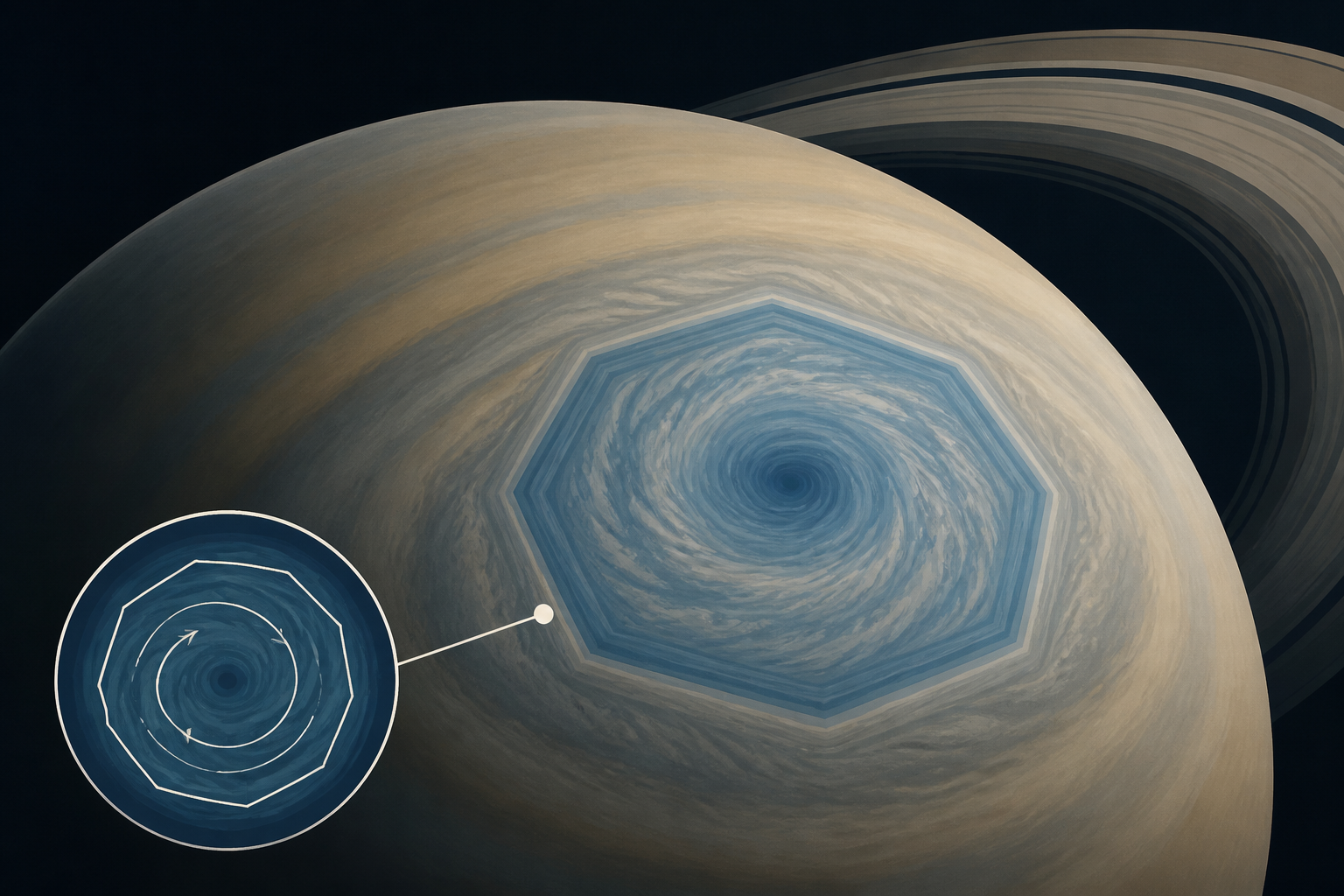
Scientists find a churning decagon over Saturn's south pole
AP News • • science
Key Points:
- Scientists have discovered a massive 10-sided wave pattern, or decagon, in the icy ammonia clouds over Saturn’s south pole, which appears larger and more unstable than the well-known hexagon at the north pole.
- The decagon was first observed by the Hubble Space Telescope in 2023 and is believed to have formed between 2017 and 2023 when Saturn’s south pole was not visible from Earth.
- Unlike the nearly stationary hexagon, the decagon moves eastward at about 6 mph, and its sides can exceed 10,000 miles in length, highlighting Saturn’s unique atmospheric dynamics.
- Researchers hope that studying both the hexagon and decagon will provide insights into the weather patterns of giant gas planets, with ongoing observations expected to reveal more about the decagon’s nature and longevity.
- The discovery challenges the notion that Saturn’s hexagon is a unique phenomenon and raises questions about possible connections to polygonal cyclones observed on Jupiter.


