AI Image
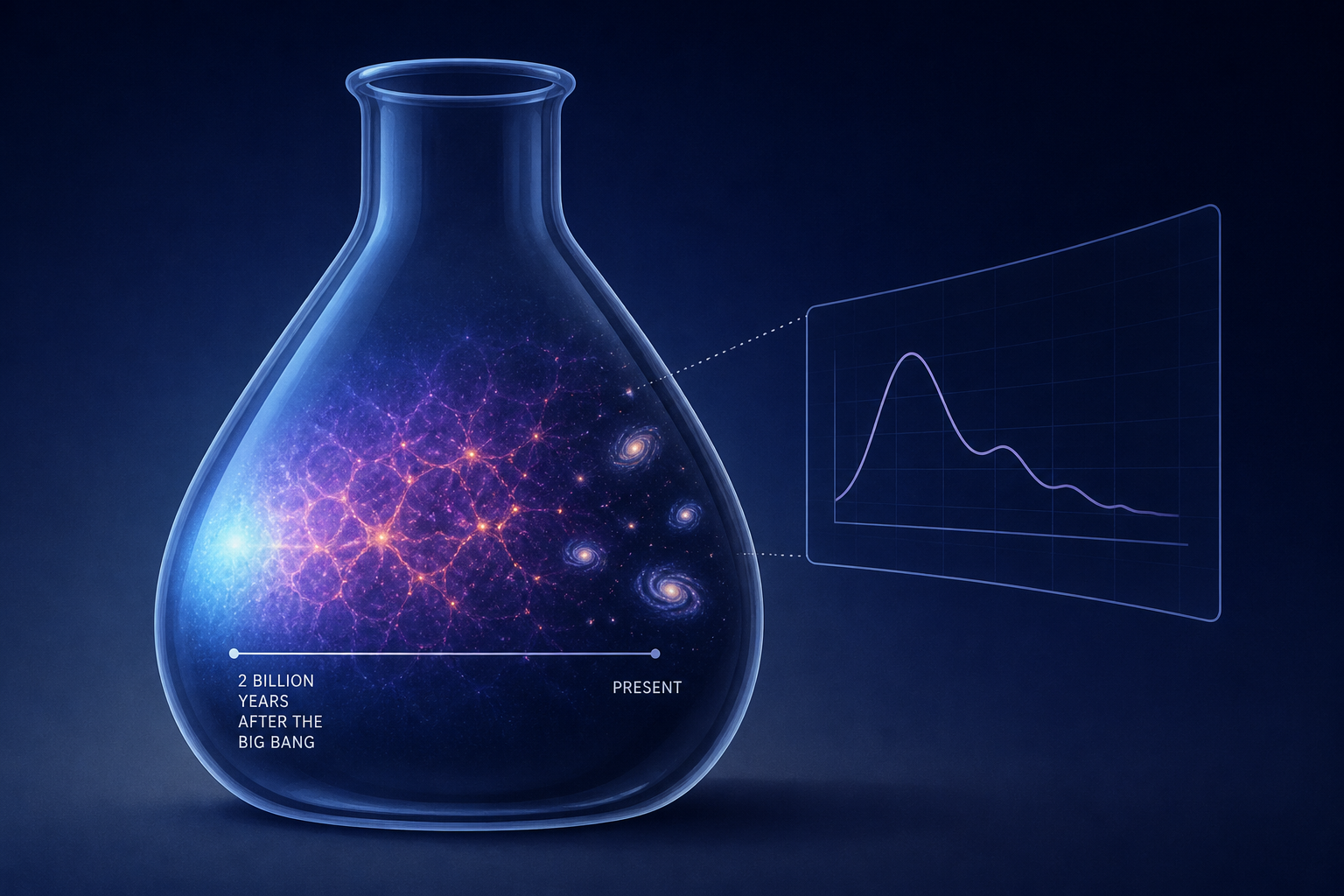
Scientists Recreate the First 2 Billion Years of the Universe in Stunning New Simulation
Yahoo • • science
Key Points:
- Researchers from MIT, Harvard & Smithsonian, and partners developed Lumina, a large-scale radiation-hydrodynamics simulation covering 1.6 billion light-years and the first 2 billion years of cosmic history to study how the universe transitioned from darkness to light.
- Lumina models the evolution of dark matter, gas, stars, galaxies, black holes, and radiation starting 50 million years after the Big Bang, uniquely including helium reionization and its feedback effects within a single simulation.
- The simulation ran on the Frontier supercomputer at Oak Ridge National Laboratory, utilizing half a trillion computational elements and covering a volume over 100 times larger than previous simulations while maintaining galaxy-level resolution.
- Lumina's predictions help interpret observations from the James Webb Space Telescope by comparing simulated galaxy properties with real data, enabling researchers to identify gaps in current understanding of star formation and black hole growth.
- As a theoretical framework shaped by assumptions and approximations, Lumina serves as a testable reference point for studying early cosmic history rather than a definitive record of events.


