AI Generated Image
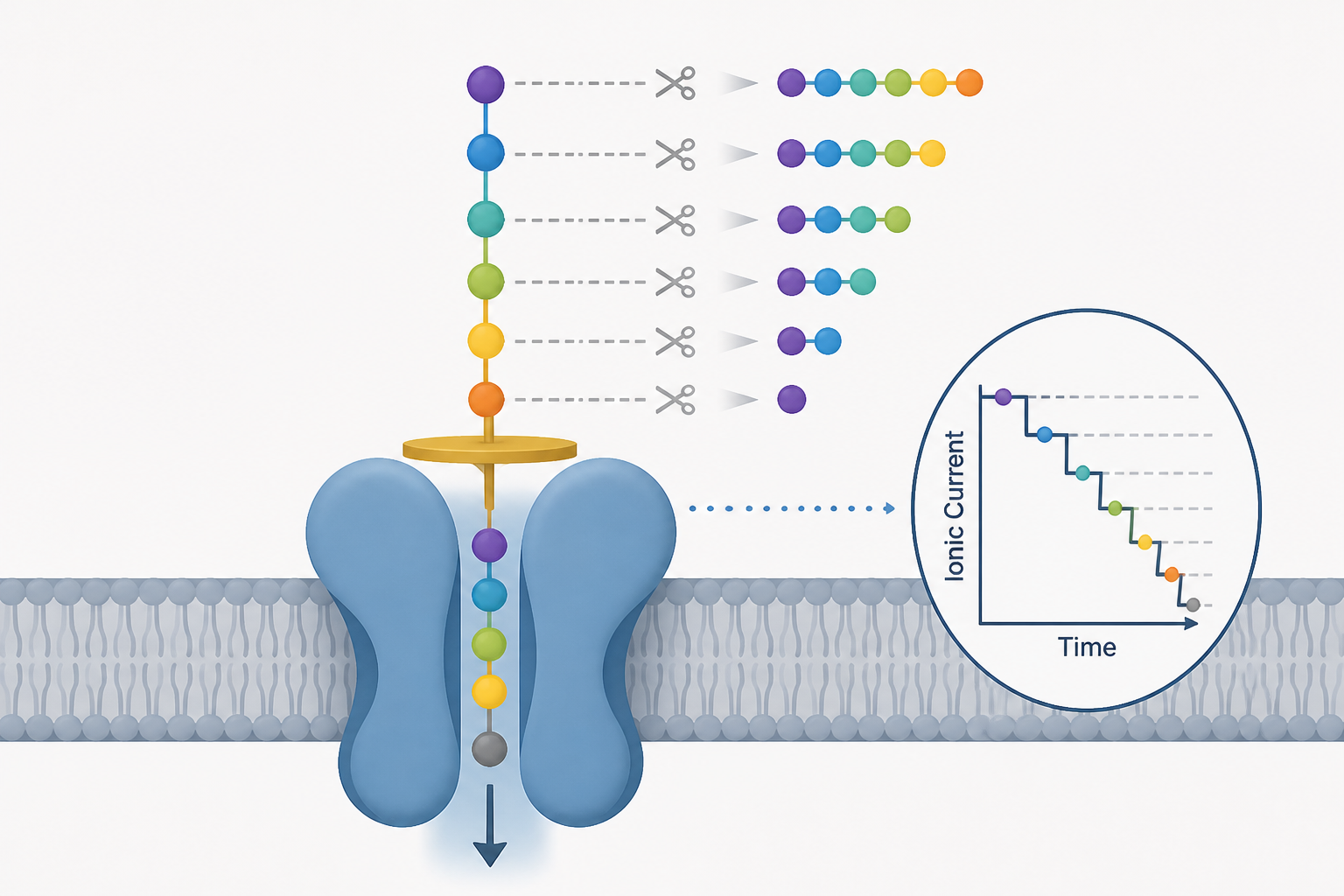
Sequential reading of a stepwise-shortened peptide immobilized on nanopore
nature.com • • health
Key Points:
- Multi-voltage sweeping (+60 mV, +100 mV, +140 mV) was used to collect 200 tPAL events per peptide at each voltage, extracting nine features per voltage to form a 27-dimensional feature matrix for machine learning classification with MATLAB’s Classification Learner toolbox, achieving up to 98.0% validation accuracy using a quadratic SVM model.
- Representative tPAL events of 20 XTRSC peptide variants revealed two types of nanopore events for peptides CTRSC, HTRSC, and PTRSC, with type-1 events linked to N-terminal coordination and type-2 to side-chain coordination; these event types help distinguish peptide variants.
- Anchoring the enzyme sgAP-dA15-chol near the nanopore via cholesterol-lipid bilayer interactions significantly improved sequential digestion efficiency of immobilized peptides compared to using sgAP–biotin, enabling observation of multiple enzymatic cleavage stages.
- Sequential cleavage experiments with various peptides, including chemically modified versions (oxidized methionine, lysine acetylation), showed distinct tPAL event patterns at each cleavage stage, allowing differentiation of peptide modifications and sequences.
- Advanced data analysis, including t-SNE visualization and sequence assembly graphs based on k-mer probabilities derived from sequential cleavage events, enabled accurate peptide variant classification and sequence reconstruction through optimal path identification.


