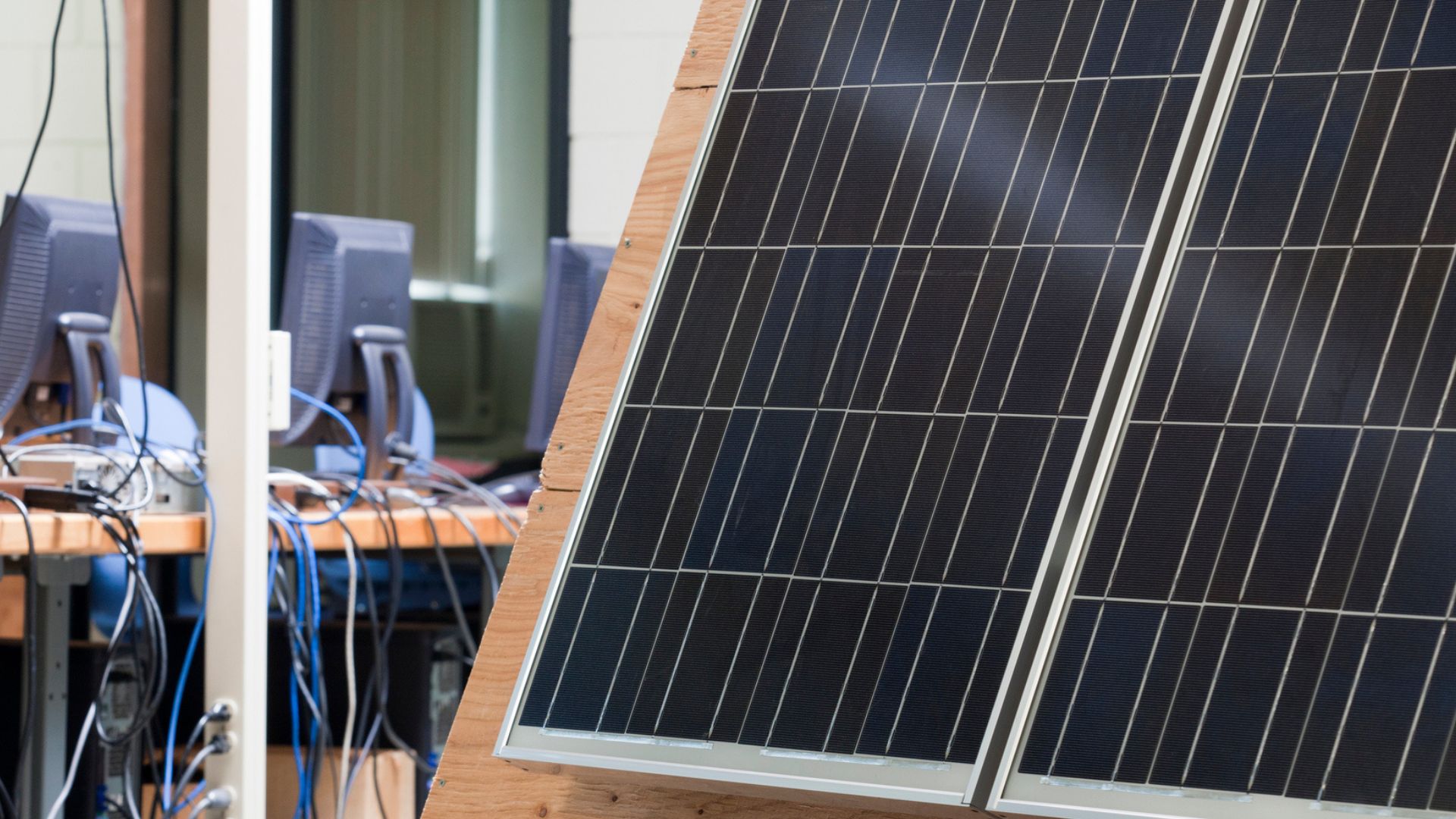
Singlet fission breaks 'ceiling' of solar cells for 130% quantum yield
Interesting Engineering • • science
Key Points:
- Researchers from Kyushu University and Johannes Gutenberg University Mainz have surpassed the traditional solar energy conversion limit by achieving a quantum yield of 130% using a novel “spin-flip” emitter, proving solar systems can generate more energy carriers than photons absorbed.
- The breakthrough overcomes the Shockley–Queisser limit by employing singlet fission (SF), a process that splits one high-energy exciton into two lower-energy triplet excitons, theoretically allowing one photon to produce two excitons.
- The team developed a molybdenum-based metal complex that selectively harvests multiplied triplet excitons by flipping electron spins, thereby avoiding energy loss through Förster resonance energy transfer (FRET) and enabling enhanced quantum efficiency.
- While the current results were demonstrated in solution, the researchers aim to transition the technology into solid-state devices, potentially leading to ultra-efficient solar panels, LEDs, and quantum computing applications with significantly reduced heat loss.
- This advancement could revolutionize solar energy by enabling panels that produce substantially more electricity from the same sunlight, accelerating the shift away from fossil fuels.


.jpg%3Fwidth%3D1200%26height%3D630%26fit%3Dcrop%26enable%3Dupscale%26auto%3Dwebp?format=webp&w=120&h=80)


