AI Generated Image
Skeletal transformation to chiral nanocarbon molecules
Nature • • science
Key Points:
- Researchers developed a method for synthesizing decagon-containing nanocarbons by oxidative inner-bond cleavage of dibenzo[g,p]chrysenes (DBCs), enabling the creation of figure-eight π-conjugated molecules called cyclobisbiphenylenecarbonyls (CBBCs) and their π-extended derivatives PhenCBBC 1, DBCCBBC 2, and HBCCBBC 3.
- The π-extended CBBCs exhibit large π-surfaces with unique conformations: PhenCBBC 1 and HBCCBBC 3 have figure-eight shapes, while DBCCBBC 2 adopts a metastable bathtub conformation; these molecules show high configurational stability, especially HBCCBBC 3, which resists racemization even at elevated temperatures.
- Photophysical studies revealed that π-extension red-shifts absorption and emission spectra, enhances fluorescence quantum yields, and suppresses nonradiative decay; notably, PhenCBBC 1 shows strong circular dichroism (CD) and circularly polarized luminescence (CPL) with dissymmetry factors significantly higher than typical chiral organic molecules.
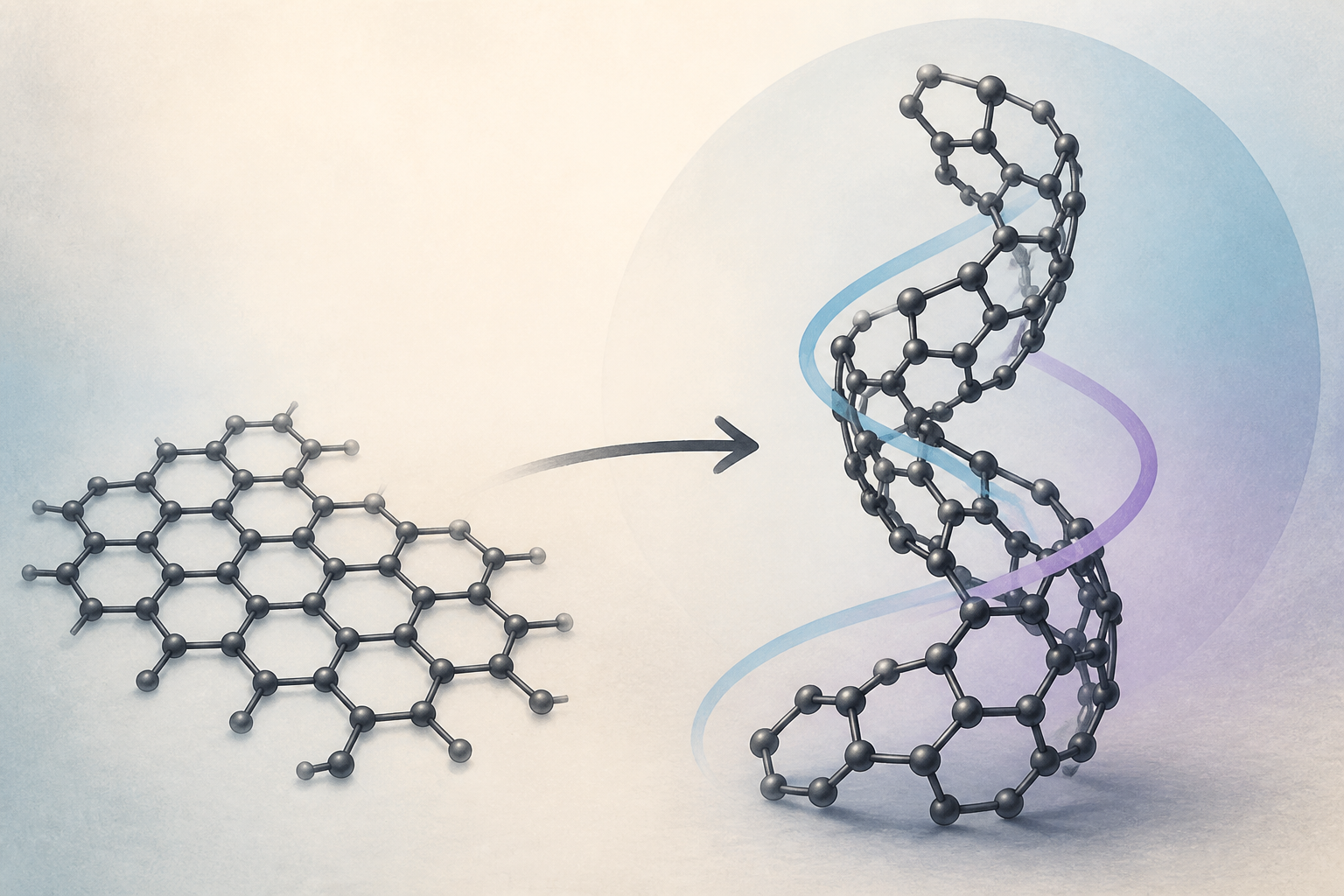
- The inner double bond of DBCCBBC 2 was successfully reformed via McMurry coupling to yield a π-extended double-helical nanographene (compound 4) with a quasi-D2-symmetric structure, exhibiting permanent porosity and chiral one-dimensional pores, highlighting potential for constructing homochiral π-stacked organic frameworks.
- The study combines experimental synthesis, structural characterization (including X-ray crystallography), spectroscopic analysis, and computational methods to demonstrate a skeletal-transformation approach for creating complex, chiral nanocarbon architectures with promising electronic, optical, and porous properties.


