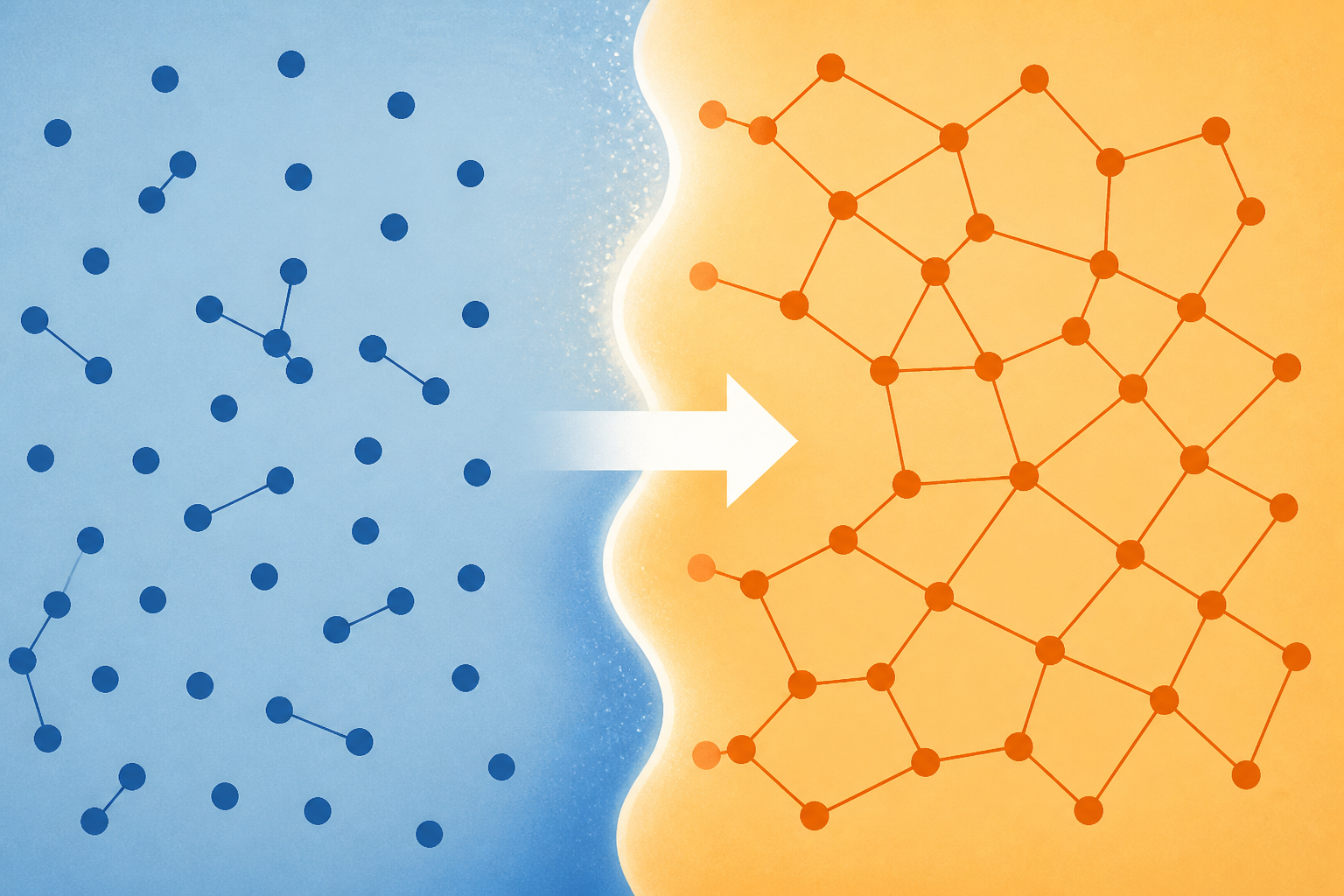
AI Generated Image
‘Stunning’ Percolation Proof Solves Decades-Old Puzzle About Phase Transitions
Quanta Magazine • • world
Key Points:
- Percolation theory studies phase transitions in networks, where above a critical probability, small fluid pools merge into large connected seas, analogous to physical phenomena like melting or magnetization.
- The sharpness conjecture predicts a rapid transition at the critical probability, with tiny pools below it and a dominant infinite sea above it; this was proven for lattice graphs in the 1980s but remained unproven for more general infinite transitive graphs.
- In 1996, Benjamini and Schramm extended percolation studies to infinite transitive graphs, showing phase transitions occur but leaving the speed of transition (sharpness) unresolved, particularly the supercritical case above the threshold.
- A breakthrough came in 2025 when a team of mathematicians in Zurich developed a novel, simpler proof of supercritical sharpness for all infinite transitive graphs by reworking a common probability technique called sprinkling, confirming that above the critical probability, fluid covers nearly the entire graph.
- This result is considered a major advance in percolation theory, opening paths to studying more complex networks and models, though questions remain about behavior at critical probability in three-dimensional lattices that model physical systems.


