Switchable 2D-3D display through a metasurface lenticular lens
Nature • • technology
Key Points:
- The efficiency of the Multilayer Laue Lens (MLL) is analyzed using Rigorous Coupled-Wave Analysis (RCWA) across different incident angles and positions, showing variation and directional bias as the coordinate \({u}_{1}\) increases due to changes in the local period and diffraction angle.
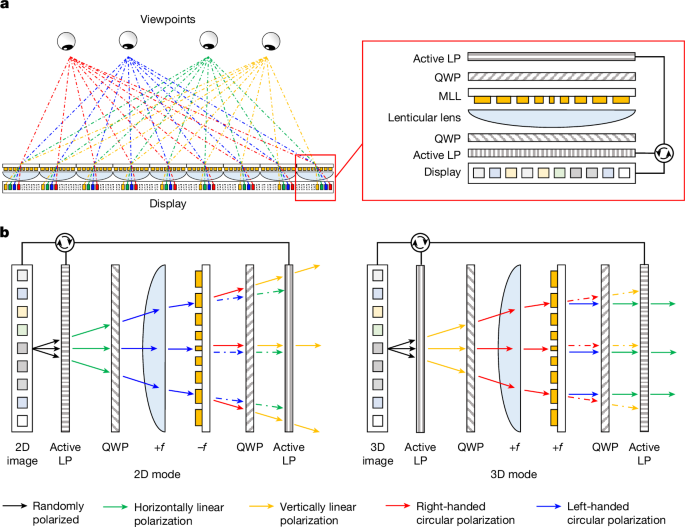
- The experimental setup involves measuring the intensity of DC noise to indirectly determine the MLL's efficiency, using polarization control elements (linear polarizers and quarter-wave plates) to modulate and analyze the incident light in a right circularly polarized (RCP) state.
- Quasi-collimated light is generated by activating a few pixels and collimated with a CCD lens, while polarization aberrations are minimized by orienting the polarizers and wave plates perpendicular to the light propagation direction.
- Measured efficiencies of the fabricated MLL at normal incidence are 26.6% for 620 nm, 46.4% for 535 nm, and 54.8% for 460 nm wavelengths, demonstrating improved efficiency at shorter wavelengths.


