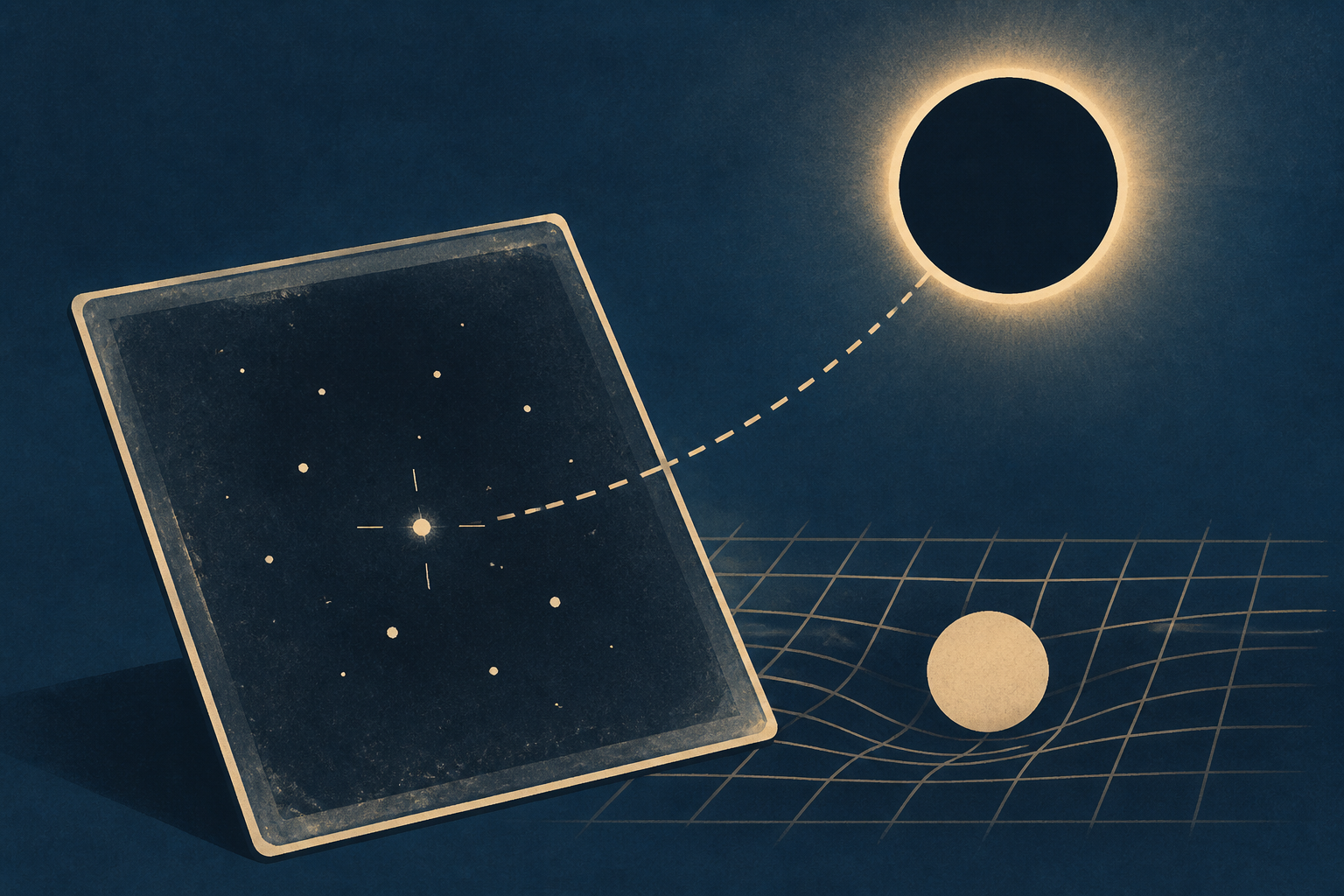
AI Generated Image
The 1919 Eclipse Plates That Proved Einstein Right
Fstoppers • • science
Key Points:
- On May 29, 1919, two teams of astronomers photographed a total solar eclipse to test Einstein's general theory of relativity by measuring the bending of starlight near the Sun, a prediction differing from Newtonian physics.
- The expeditions, led by Arthur Eddington on Príncipe and Andrew Crommelin and Charles Davidson in Sobral, Brazil, faced challenges such as bad weather and instrument issues, but ultimately produced measurements supporting Einstein's predicted deflection of about 1.75 arcseconds.
- Despite some controversy over data selection and analysis, the results announced in November 1919 were hailed as a revolutionary confirmation of Einstein's theory, elevating him to worldwide fame and marking a major shift in physics.
- Subsequent experiments and modern techniques have repeatedly confirmed the bending of starlight, now a fundamental tool in astrophysics known as gravitational lensing, used to study dark matter and distant galaxies.
- The original 1919 eclipse plates are lost, but their legacy endures as they captured the first direct evidence of spacetime curvature, fundamentally changing our understanding of gravity and the universe.


