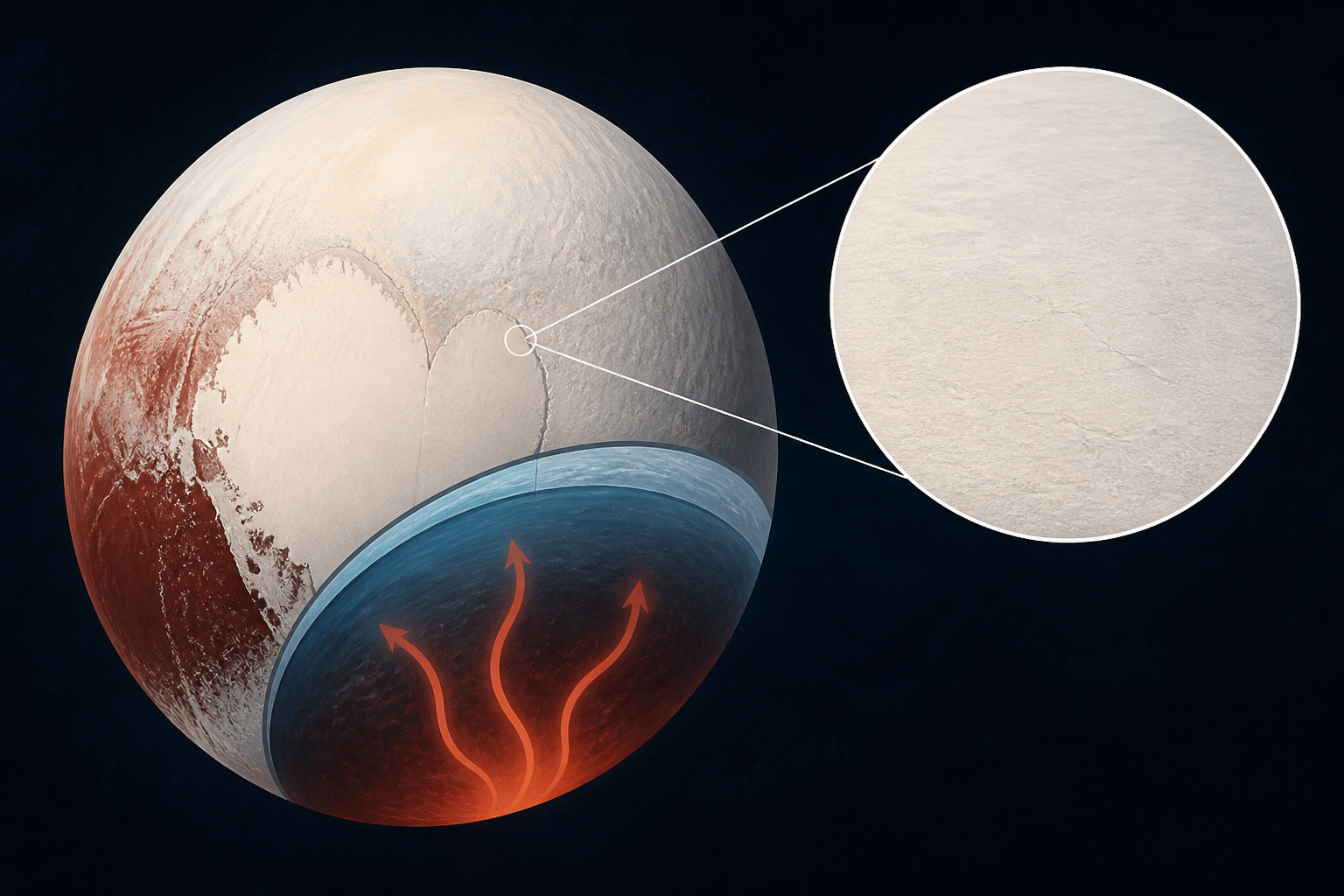
AI Generated Image
The bright nitrogen ice plain forming the left lobe of Pluto's heart has not a single impact crater anywhere on it, which tells planetary scientists the surface is being churned from below and complet
Space Daily • • science
Key Points:
- Sputnik Planitia, a 1,000-kilometre-wide basin on Pluto filled with nitrogen ice, shows no confirmed impact craters, indicating a surface age of less than about 10 million years based on crater statistics and impact rate models.
- The basin's surface is a glacier of soft nitrogen ice that flows and deforms over time, carrying water-ice blocks and undergoing processes like convection, glacial flow, sublimation, and condensation, which collectively renew the terrain and erase craters.
- Surface cells 10 to 40 kilometres wide exhibit polygonal patterns caused by convection within a thick nitrogen ice layer, where ice circulates over roughly 500,000 years, continuously renewing the surface and hiding impact scars.
- While crater counts set an upper age limit, the actual surface exposure age can be much younger, with parts of Sputnik Planitia's surface potentially younger than the 315,000-year-old earliest Homo sapiens fossils, reflecting ongoing geological activity rather than the age of the basin itself.
- Scientists continue to study the convection mechanism driving the ice circulation, debating whether internal heat from Pluto's interior or cooling from surface sublimation primarily powers the motion, but all agree the plain is geologically active and constantly reshaped.


