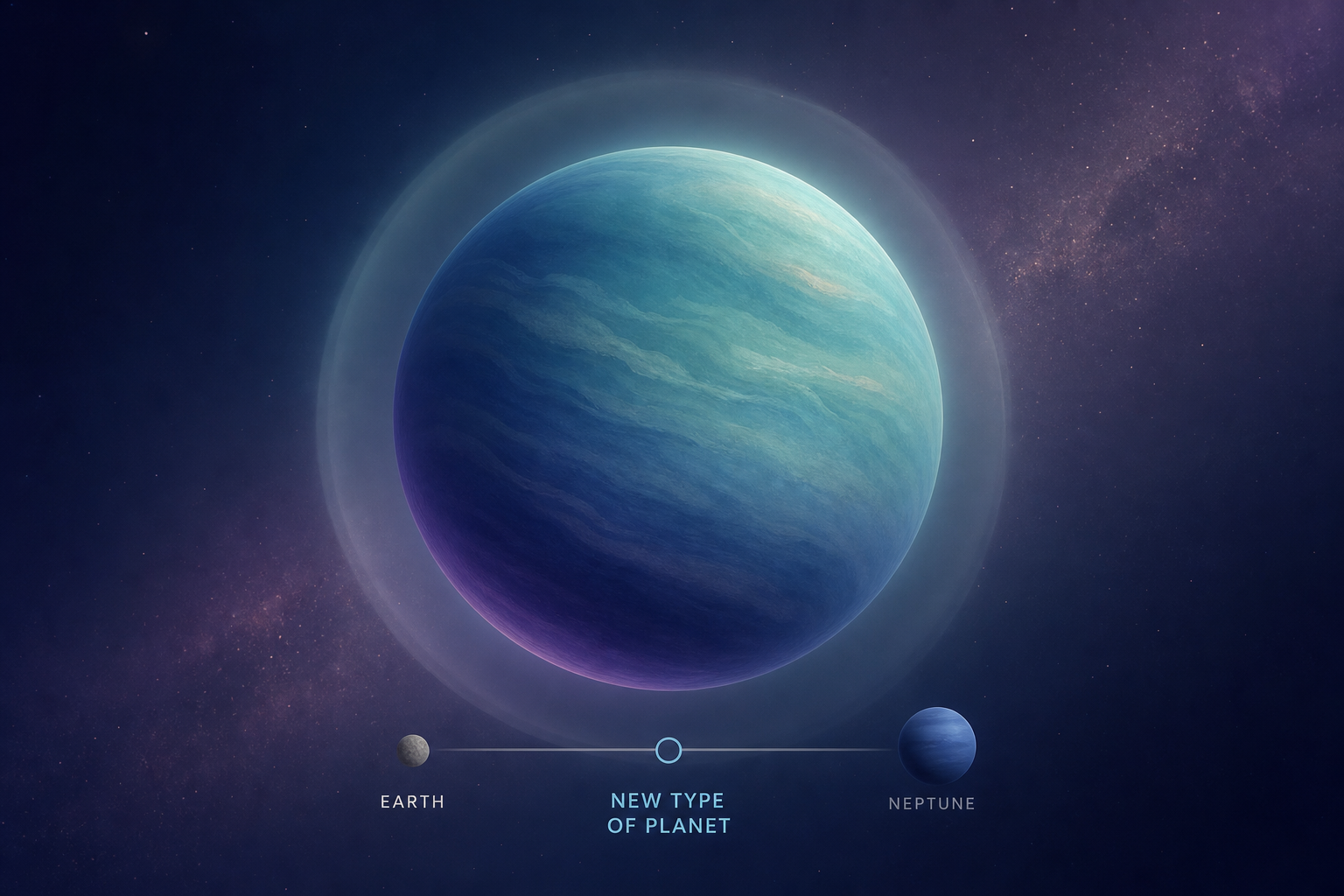
AI Generated Image
The most common type of planet discovered in the Milky Way may be a world that does not exist in our solar system — larger than Earth, smaller than Neptune, and wrapped in an atmosphere we barely unde
Space Daily • • science
Key Points:
- Exoplanet surveys have revealed a common class of planets called sub-Neptunes, which are larger than Earth but smaller than Neptune, yet no such planets exist in our Solar System, presenting a challenge for astronomers.
- Sub-Neptunes vary widely in composition, potentially being rocky cores with thin atmospheres, water-rich worlds, or mini-Neptunes with thick atmospheres, making it difficult to determine their nature based solely on size and mass.
- A notable radius gap between 1.5 and 2 Earth radii suggests some planets lose their atmospheres over time due to stellar radiation, leading to a divergence between rocky super-Earths and gas-rich sub-Neptunes, though this does not fully explain their diversity.
- Atmospheric studies, such as those using the James Webb Space Telescope, have shown that sub-Neptunes often have thick clouds or hazes that obscure spectral features, complicating efforts to characterize their atmospheres and compositions.
- The discovery of sub-Neptunes challenges the traditional Solar System-based classification of planets, indicating that our planetary system may be unusual and that these planets represent a fundamentally new class requiring further observation and study.


