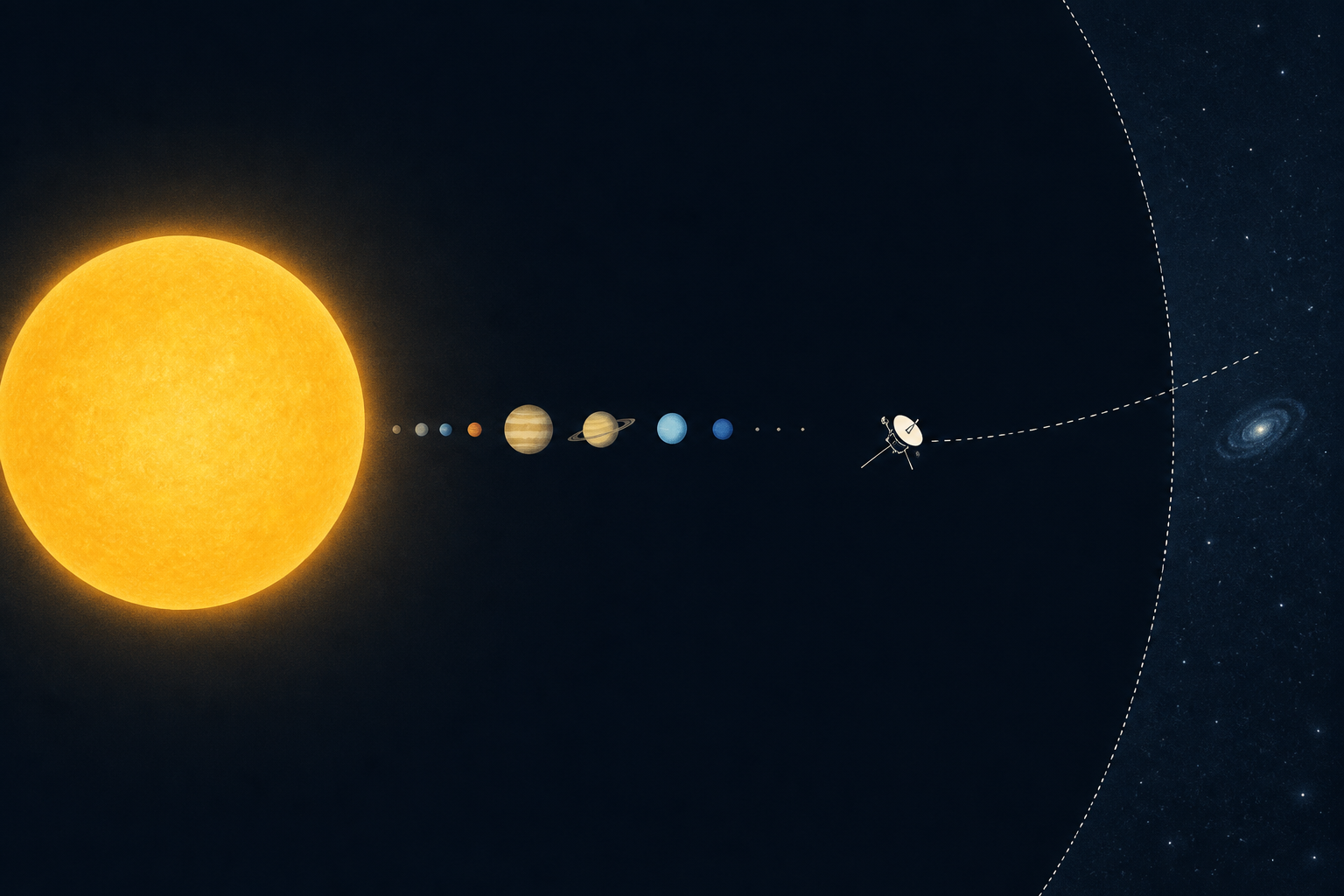
AI Generated Image
The tidy diagram of our solar system is misleading: the Sun holds about 99.86 per cent of its mass, Voyager 1 reached interstellar space in 2012 yet the true edge may lie more than a light-year furthe
Space Daily • • science
Key Points:
- The solar system is overwhelmingly dominated by the Sun, which contains about 99.86% of its total mass, with the planets and other bodies making up only a tiny fraction, mostly Jupiter.
- The distances between planets are vast, making the solar system mostly empty space; for example, if the Sun were a beach ball, Earth would be a peppercorn tens of meters away, and Neptune would be nearly a kilometer distant.
- The solar system’s boundary is complex: planets end at Neptune, but the Sun’s influence extends to the heliopause about 120 times Earth’s distance, crossed by Voyager spacecraft, and even further to the Oort Cloud, a distant, hypothesized shell of icy bodies up to a couple of light-years away.
- Beyond Neptune lies the Kuiper Belt, home to icy objects like Pluto, and there is a hypothesis for a ninth planet far beyond known planets, though it remains unconfirmed and debated among astronomers.
- Unlike simplified classroom diagrams, the true solar system is a dominant star surrounded by tiny worlds and vast, mostly unexplored space extending toward neighboring stars, with much still to be discovered.


