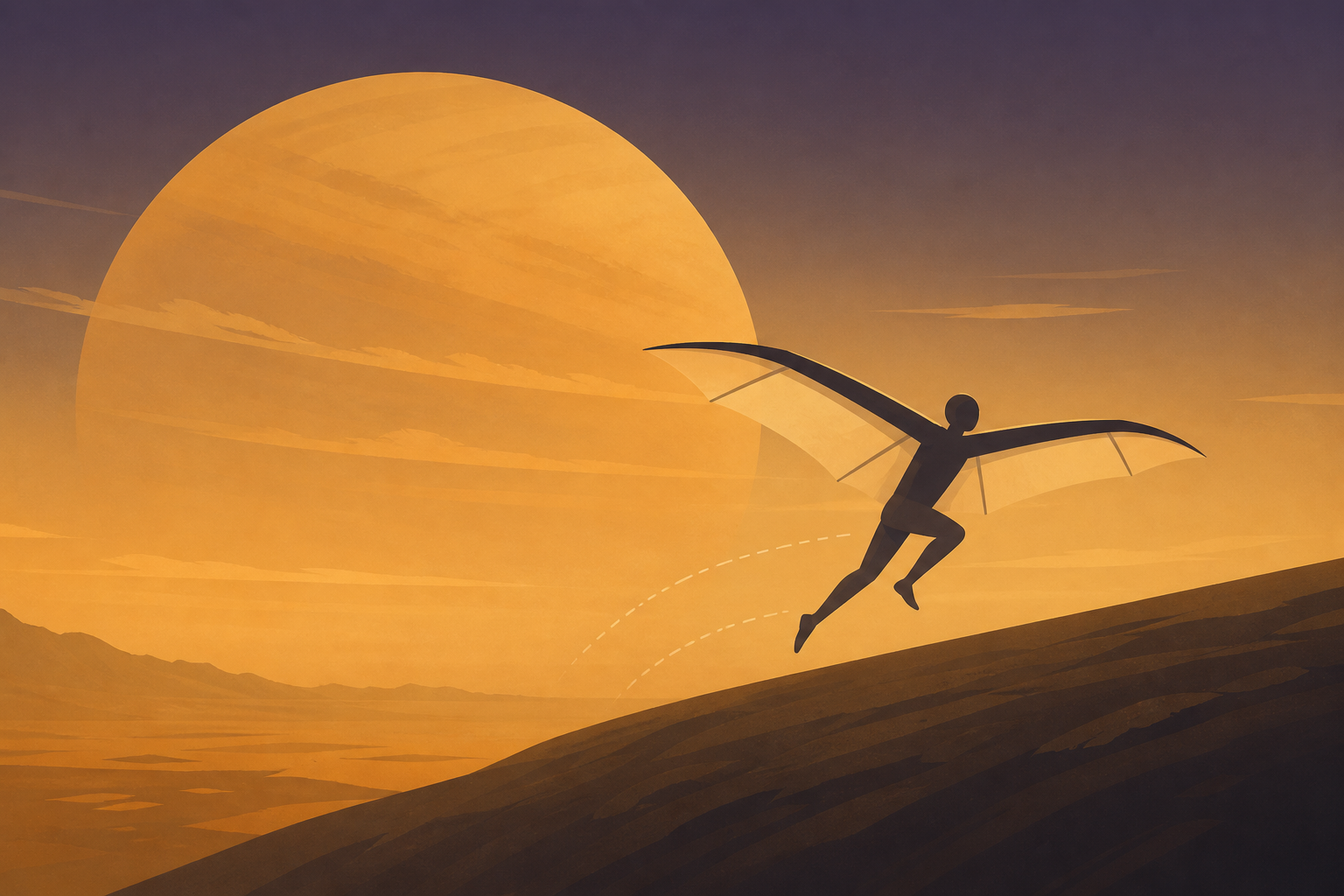
AI Generated Image
Titan's air is four times thicker than ours and its gravity a seventh as strong, which means a human being there could in principle fly under their own muscle power — strap on wings, run a few paces,
Space Daily • • science
Key Points:
- Titan, Saturn’s largest moon, has a dense atmosphere and weak gravity, making human-powered flight theoretically possible by reducing weight and increasing lift.
- Titan’s surface air density is 4.3 times that of Earth, while its gravity is about one-seventh, meaning a person would weigh significantly less and require less effort to become airborne.
- NASA’s upcoming Dragonfly mission leverages Titan’s unique conditions, using an eight-rotor drone designed to fly efficiently in the dense atmosphere and low gravity, aiming to explore over 100 miles during its mission.
- Despite the ease of flight, Titan’s extreme cold (around -179°C) and lack of breathable oxygen present major survival challenges, requiring heated, oxygen-supplied suits that complicate any human attempt at flying.
- The concept highlights how human limitations on Earth are shaped by environmental conditions, suggesting that what seems impossible here could be achievable under different planetary physics.


