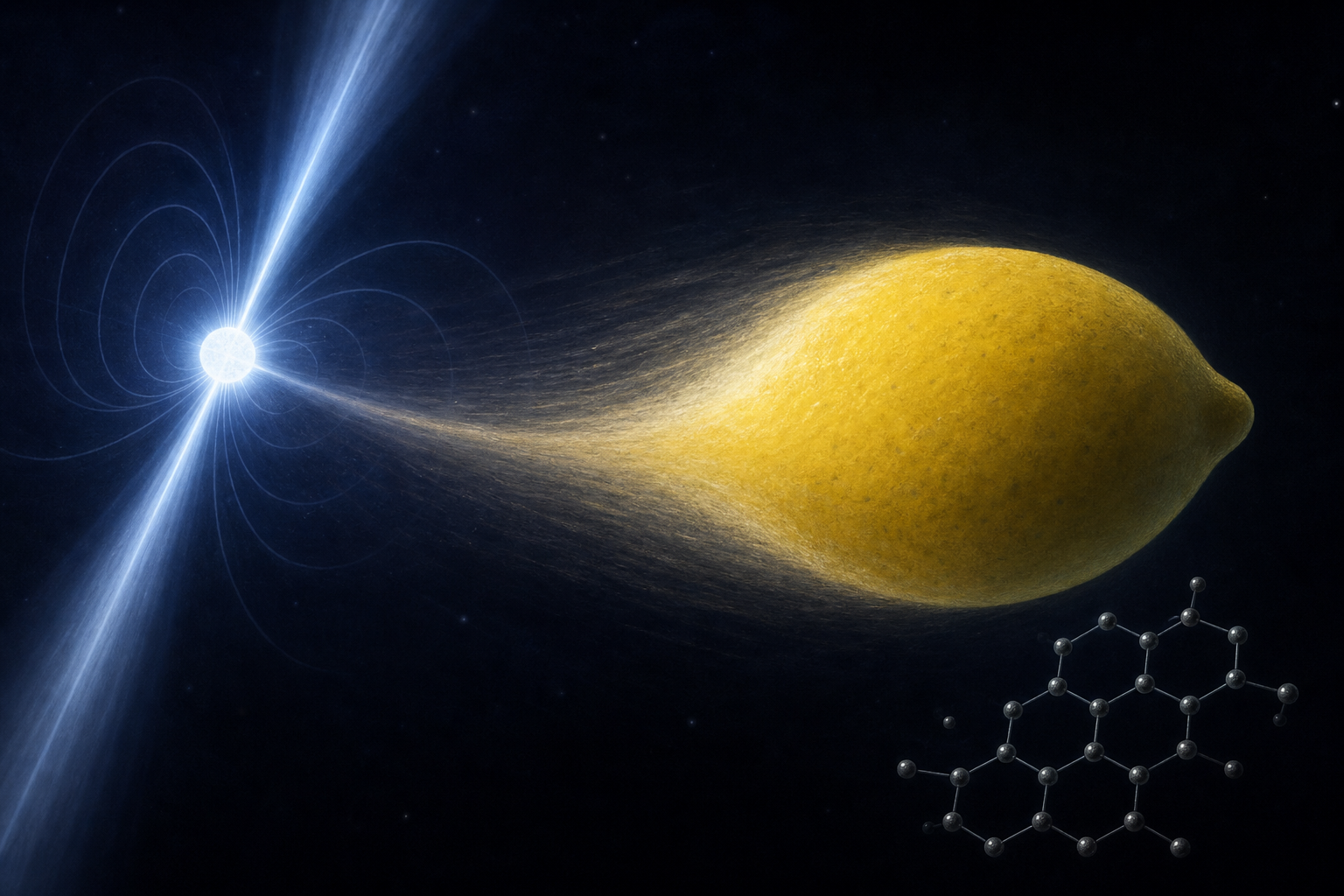
AI Generated Image
Webb found a planet stretched into a lemon shape around a pulsar, with an atmosphere of carbon that seems to rule out every way we know of forming it
Space Daily • • science
Key Points:
- The James Webb Space Telescope observed the planet PSR J2322-2650b orbiting a millisecond pulsar and discovered its atmosphere is dominated by molecular carbon (C2 and C3), a composition nearly unseen in planetary atmospheres.
- The planet, roughly Jupiter-sized and distorted into a lemon shape by the pulsar's intense gravity, orbits extremely close to its star, completing an orbit in just 7.8 hours, with surface temperatures ranging from about 1,200 to 3,700 degrees Fahrenheit.
- The extreme carbon-to-oxygen and carbon-to-nitrogen ratios challenge all known planet formation theories, leaving scientists puzzled about how such a planet could form, especially given the pulsar's "black widow" system context.
- While the data and models are robust, the conclusions about the planet's unusual composition and formation remain interpretative and based on a single object and instrument; hypotheses such as carbon crystallization inside the planet are proposed but incomplete.
- This discovery marks the first detection of a molecular carbon-dominated atmosphere on an exoplanet and highlights gaps in understanding planetary formation, providing an intriguing puzzle for future research.


