AI Generated Image
Webb reveals warped structure in nearby TW Hydrae's protoplanetary disk
Phys.org • • science
Key Points:
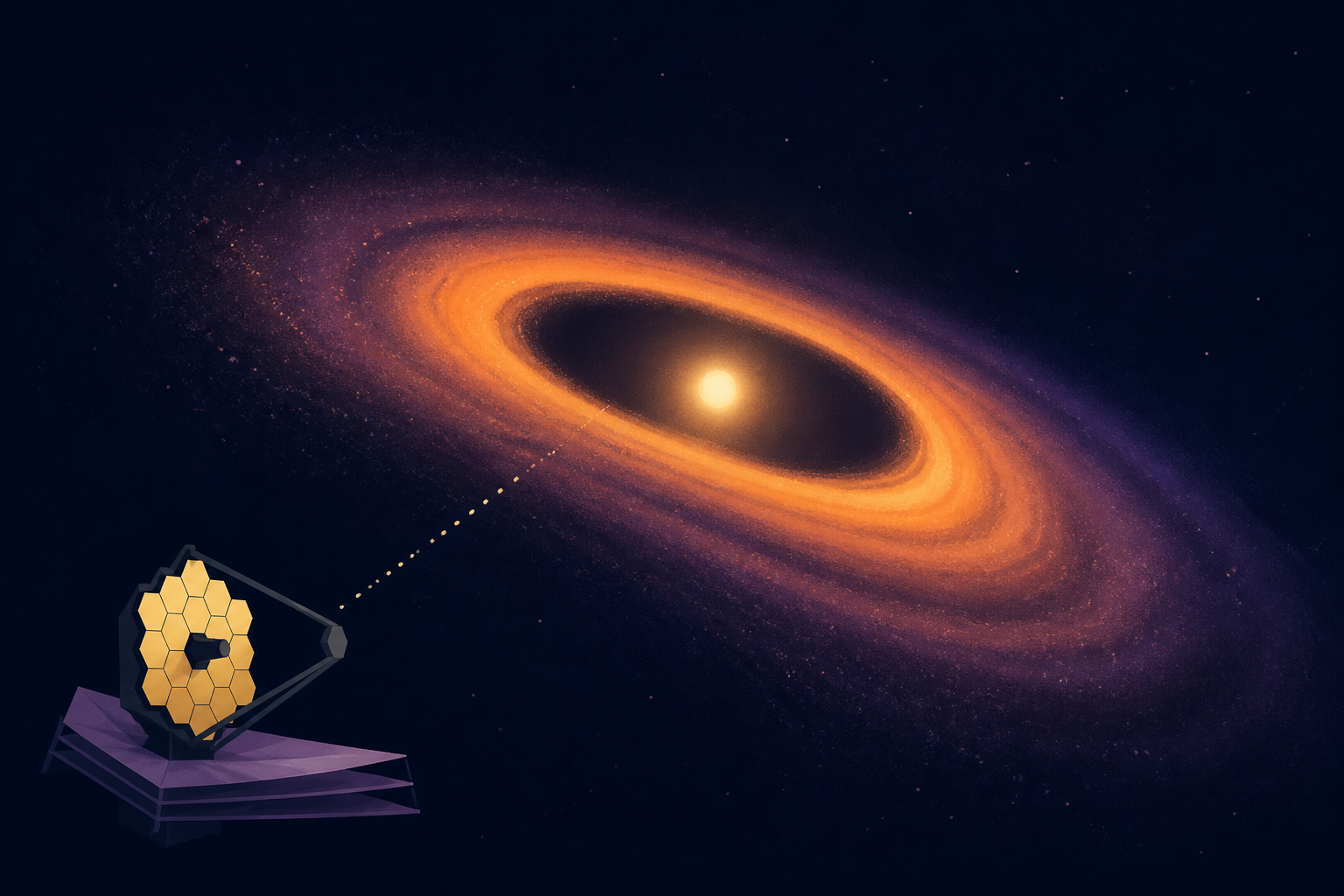
- Using the James Webb Space Telescope's Near Infrared Camera (NIRCam), astronomers captured high-contrast images of the protoplanetary disk around TW Hydrae, the closest such disk to Earth at 194 light-years away.
- The observations revealed a warped disk structure with an average inclination of 8.74 degrees and a brighter disk surface than previously recorded, dominated by micron- to submicron-sized dust grains.
- A distinct bifurcation feature was identified at 120 AU from the star, suggesting complex substructures likely caused by planet-disk interactions.
- The study ruled out the presence of nonembedded companion planets larger than 0.4 Jupiter masses beyond 60 AU and larger than two Jupiter masses beyond 30 AU, implying that any planets shaping the disk are either smaller or hidden by dust.
- These findings enhance understanding of planetary formation and the chemical environment in protoplanetary disks, which may influence emerging planetary systems.


