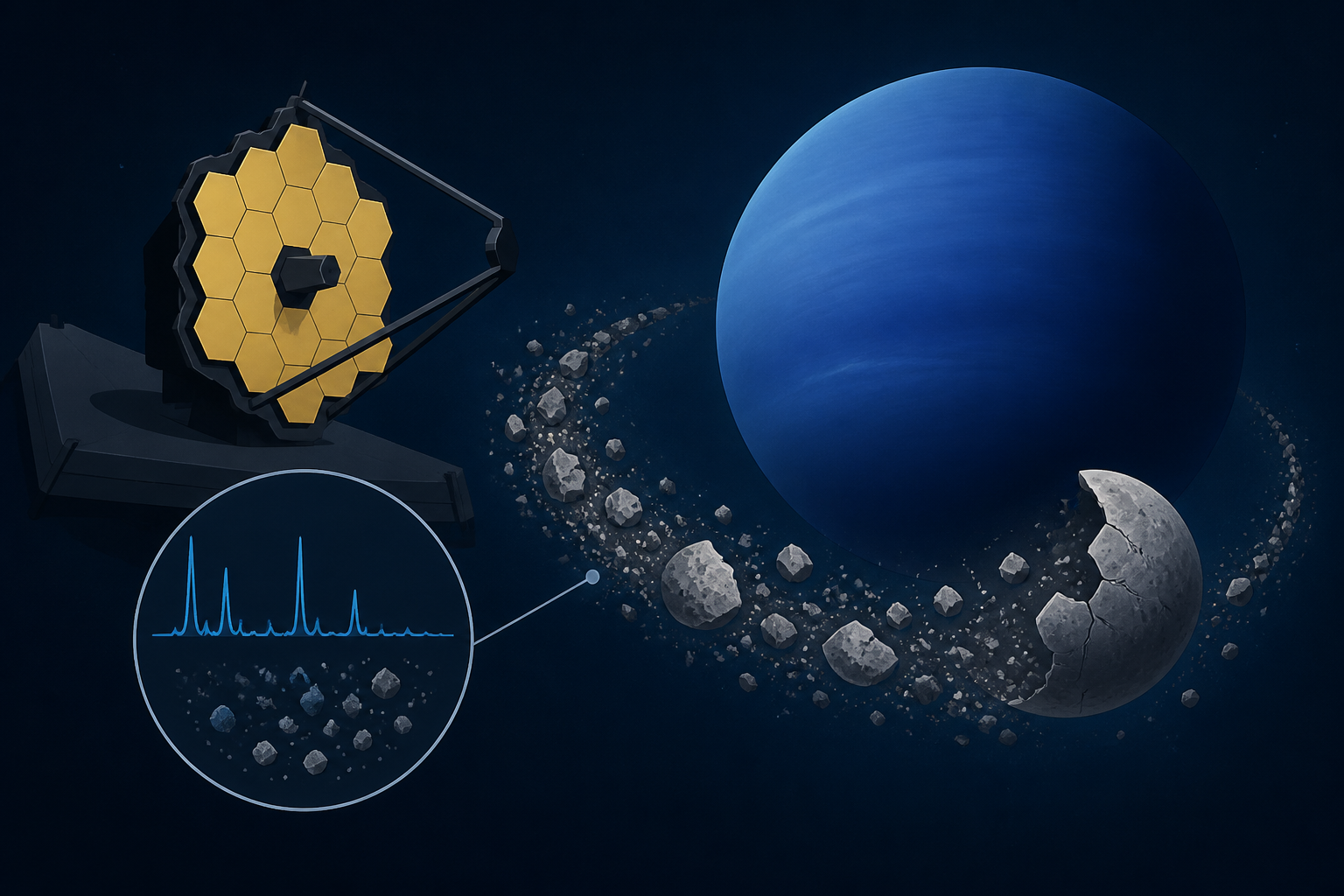
AI Generated Image
Webb Telescope Found Forensic Evidence of Ancient Disaster That Destroyed Neptune’s Moons
Yahoo • • science
Key Points:
- Approximately four billion years ago, Neptune had a stable system of large moons, which was disrupted by the arrival of a Pluto-sized body from the Kuiper Belt, likely Triton, that destroyed the original moons.
- The James Webb Space Telescope detected magnesium-rich clay minerals on Neptune's small inner moons and rings, indicating these materials originated from the interiors of larger, now-destroyed icy bodies, as such minerals form only through prolonged water-rock interaction.
- Triton, Neptune's largest moon, orbits in a retrograde direction and comprises over 99% of the system's mass, supporting the theory that it was a captured Kuiper Belt object whose arrival obliterated Neptune's original satellite system.
- The current smaller moons and rings are considered remnants of the ancient destruction, with Nereid possibly being a surviving original moon, while alternative scenarios involving other Kuiper Belt objects are less supported.
- This catastrophic event has created a unique opportunity for scientists to study exposed deep interiors of large icy worlds on Neptune's moons, providing insights not accessible on other icy bodies like Europa or Enceladus.


