AI Image
A 367-Year-Old Physics Problem Just Got a Surprising Quantum Twist
ScienceAlert • • science
Key Points:
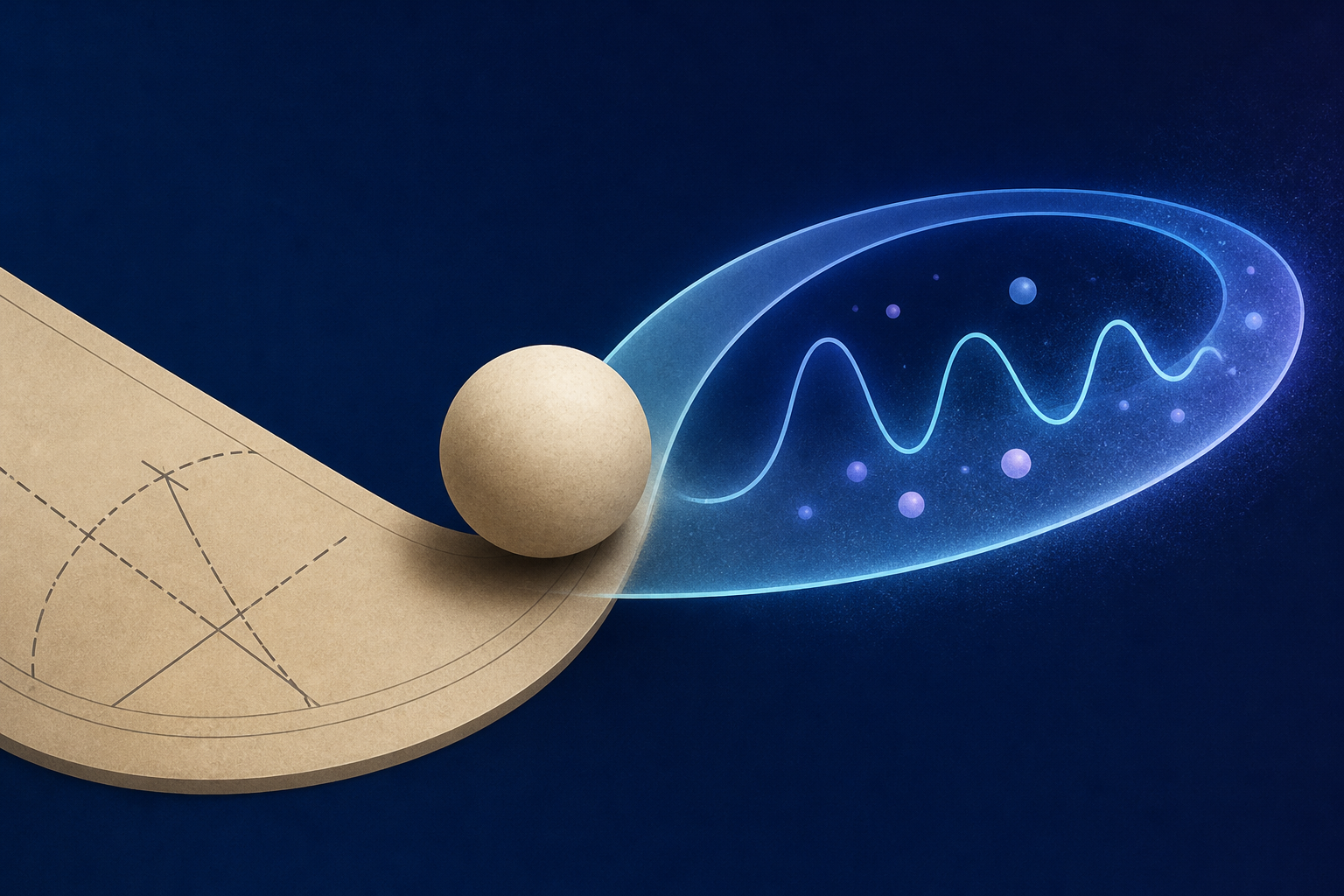
- The tautochrone problem, originally solved by Christiaan Huygens in 1659 as a cycloid curve where balls released from different heights take the same time to reach the bottom, has now been extended into quantum mechanics by physicist Georgios K. Simopoulos and colleagues.
- In the quantum tautochrone, quantum particles such as bosons and fermions hopping between sites in photonic and atomic lattices can be mathematically controlled to converge simultaneously at a central point, analogous to the classical tautochrone but without gravity or physical balls.
- Bosons can occupy the same lattice site simultaneously upon convergence, whereas fermions, restricted by the Pauli exclusion principle, arrive together but occupy separate sites; interactions between bosonic atoms affect their convergence timing depending on whether the interaction is attractive or repulsive.
- Strong interactions between atoms prevent them from converging on the same site due to energy conservation constraints limiting their movement energy range within the lattice, causing them to occupy separate nearby sites instead.
- Although currently theoretical, the quantum tautochrone effect could have practical applications in quantum technologies involving controlled particle convergence for information processing, and it raises new research questions about its behavior in complex many-body quantum systems and other physical settings.


