AI Generated Image
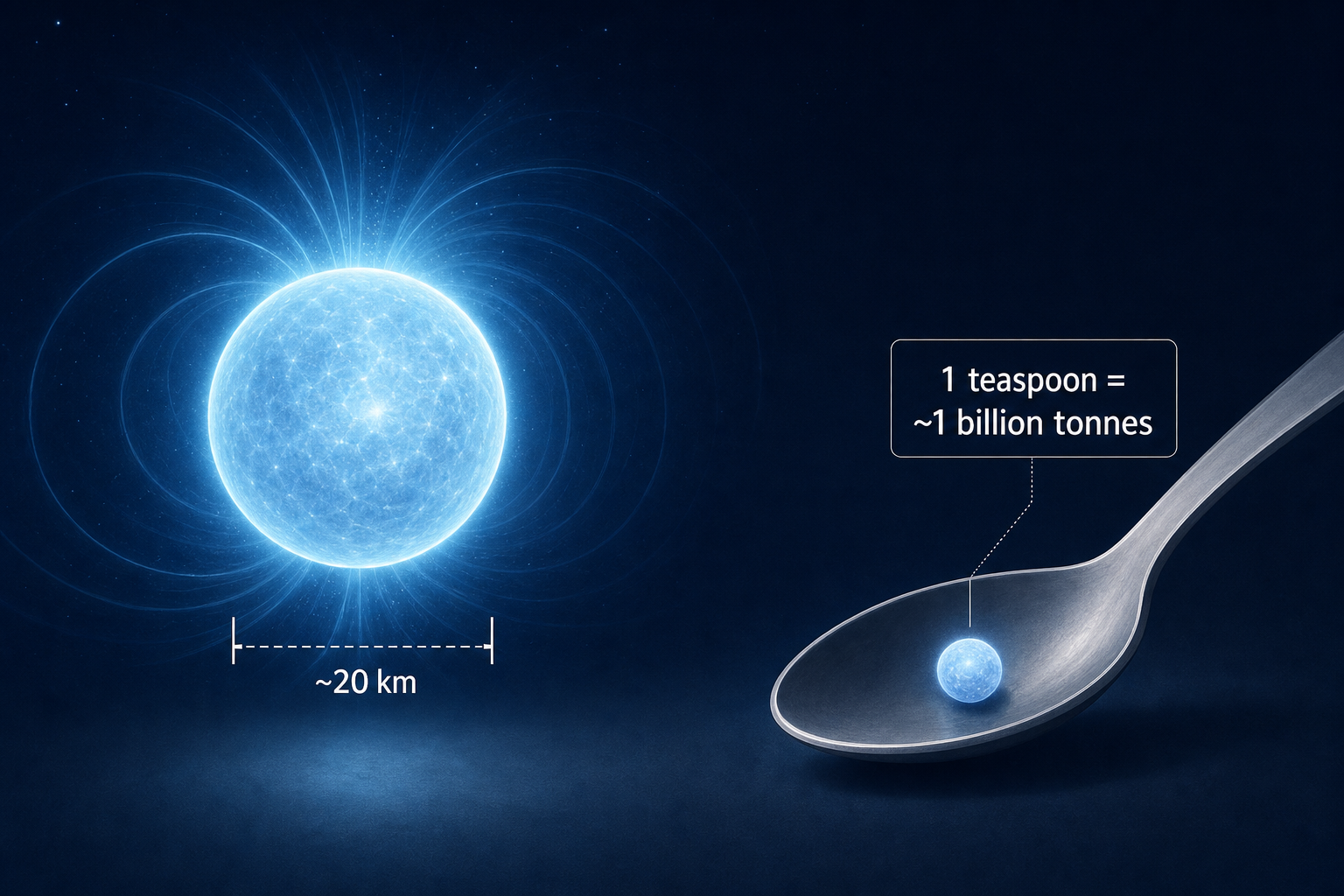
A neutron star can pack more mass than our entire Sun into a sphere only about 20 kilometres across — roughly the size of a city — and a teaspoon of its material would weigh about a billion tonnes on
Space Daily • • science
Key Points:
- Neutron stars are remnants of massive stars that have collapsed, compressing about one to two times the Sun’s mass into a sphere roughly 20 kilometers in diameter, comparable to the size of a large city.
- The density of neutron stars is extreme, with a sugar-cube-sized amount of their matter weighing about one billion tons on Earth, illustrating a scale of density far beyond ordinary experience.
- These stars are not uniform but have layered structures including a crust, neutron-rich regions, and a core with uncertain composition, making them natural laboratories for studying ultra-dense matter under conditions unattainable on Earth.
- Neutron stars can rotate rapidly and have intense magnetic fields, sometimes observed as pulsars or magnetars, emitting beams of radiation or bursts of high-energy radiation due to their dynamic magnetic activity.
- The common metaphor of a teaspoon of neutron star material weighing a billion tons is a useful but imperfect way to convey their density, emphasizing equivalent mass rather than a physically stable sample outside the star’s extreme gravity.


