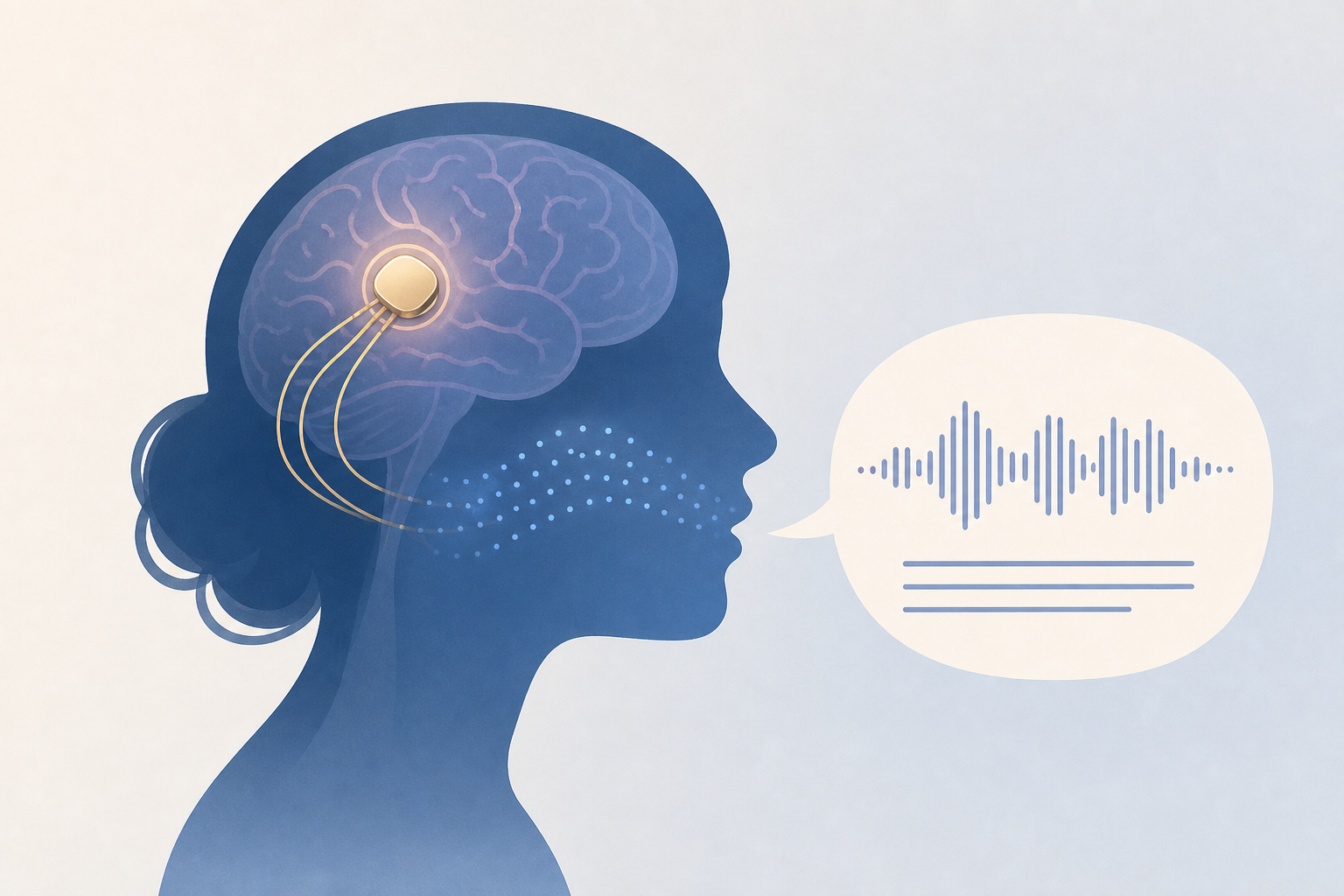
AI Generated Image
A woman who hadn't spoken an intelligible word in twenty years, silenced by a stroke, can form spoken sentences again — not by moving her mouth but through an experimental implant that reads the speec
Space Daily • • health
Key Points:
- A brain implant developed by researchers at UCSF and UC Berkeley enables a stroke survivor, known as Ann, to produce synthesized speech resembling her own voice by decoding brain signals intended for speech motor control, despite her inability to move speech muscles since 2005.
- The implant uses a 253-electrode array on the speech sensorimotor cortex and converts neural signals into audio in near real-time, with a median latency of about 1.67 seconds from prompt to speech output, significantly improving on earlier systems with delays up to eight seconds.
- The technology decodes attempts to speak rather than thoughts or inner monologue, and due to lack of residual vocalization, the team used synthetic audio conditioned on a pre-injury voice sample to train the system, though expressive speech features like intonation remain unaddressed.
- Current results are based on a single participant, and the device remains investigational, wired to external computers, with ongoing challenges including calibration complexity, limited generalizability, and absence of independent home use without researchers present.
- Subsequent research from other teams has demonstrated related advancements, including instantaneous voice synthesis and extended at-home use of brain-computer interfaces decoding text, highlighting key future milestones such as replication in additional participants, wireless system development, and real-world accuracy validation.


