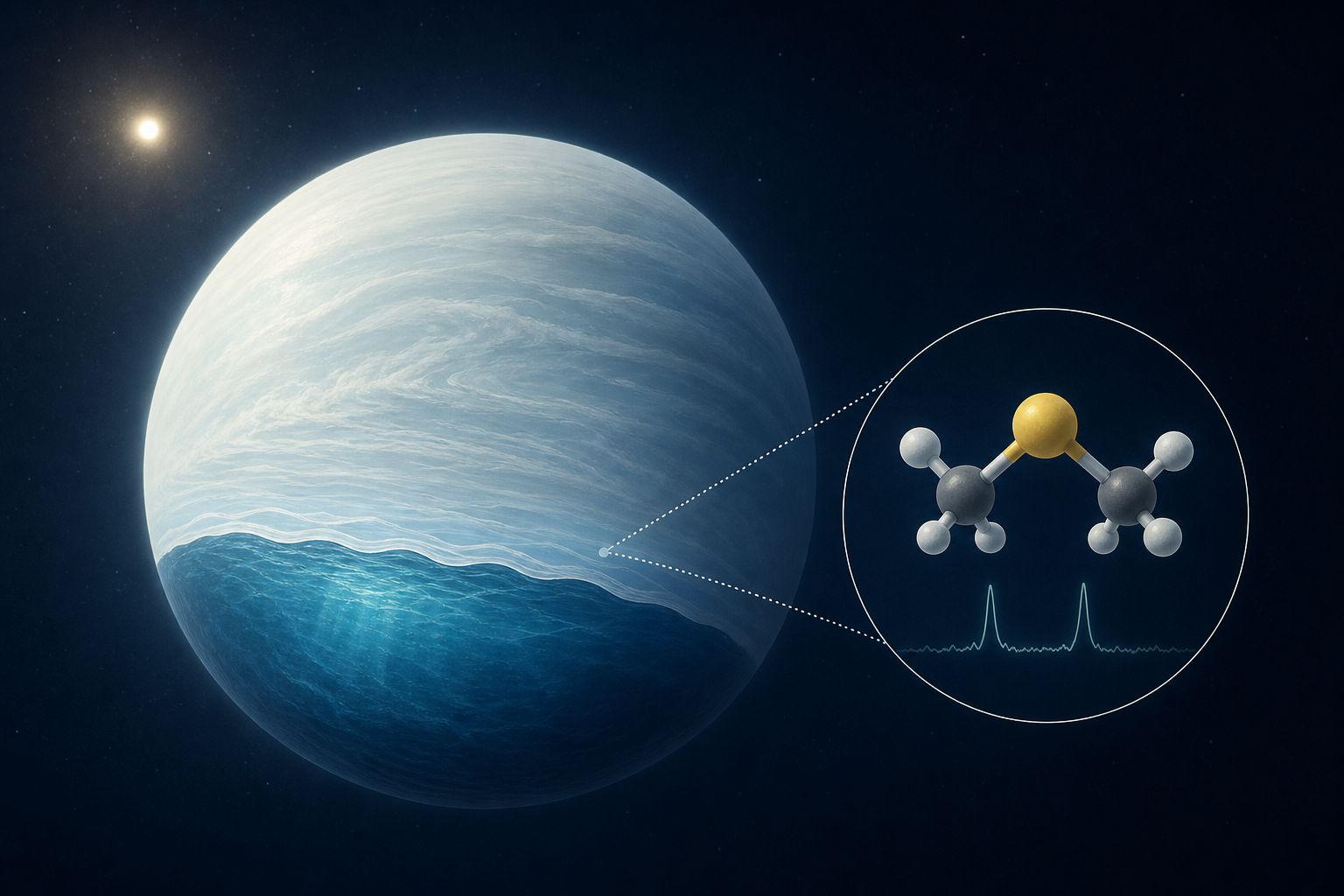
AI Generated Image
An exoplanet 124 light-years away may harbour a global ocean beneath a hydrogen-rich atmosphere. Webb has produced two tentative hints of dimethyl sulfide—a gas produced mainly by marine microorganism
Space Daily • • science
Key Points:
- K2-18b, a sub-Neptune exoplanet 124 light-years away, is a prime candidate in the search for extraterrestrial life due to its potential as a "hycean" world with a hydrogen-rich atmosphere over a global liquid ocean.
- The James Webb Space Telescope (JWST) data have shown tentative hints of dimethyl sulfide (DMS), a gas on Earth mainly produced by marine microorganisms and considered a potential biosignature.
- Multiple independent reanalyses of the same JWST data have challenged the DMS detection, suggesting the signals are weak, possibly attributable to noise, or could be explained by other molecules, leading to no consensus on its presence.
- Even if DMS were confirmed, it would not conclusively indicate life since the molecule can form through non-biological processes and the nature of K2-18b itself—whether it has a habitable ocean or a gas-dominated atmosphere—is still uncertain.
- Resolving these uncertainties requires more precise JWST observations, independent analyses with agreed-upon detection standards, and cautious interpretation to avoid premature claims about biosignatures on exoplanets.


