AI Generated Image
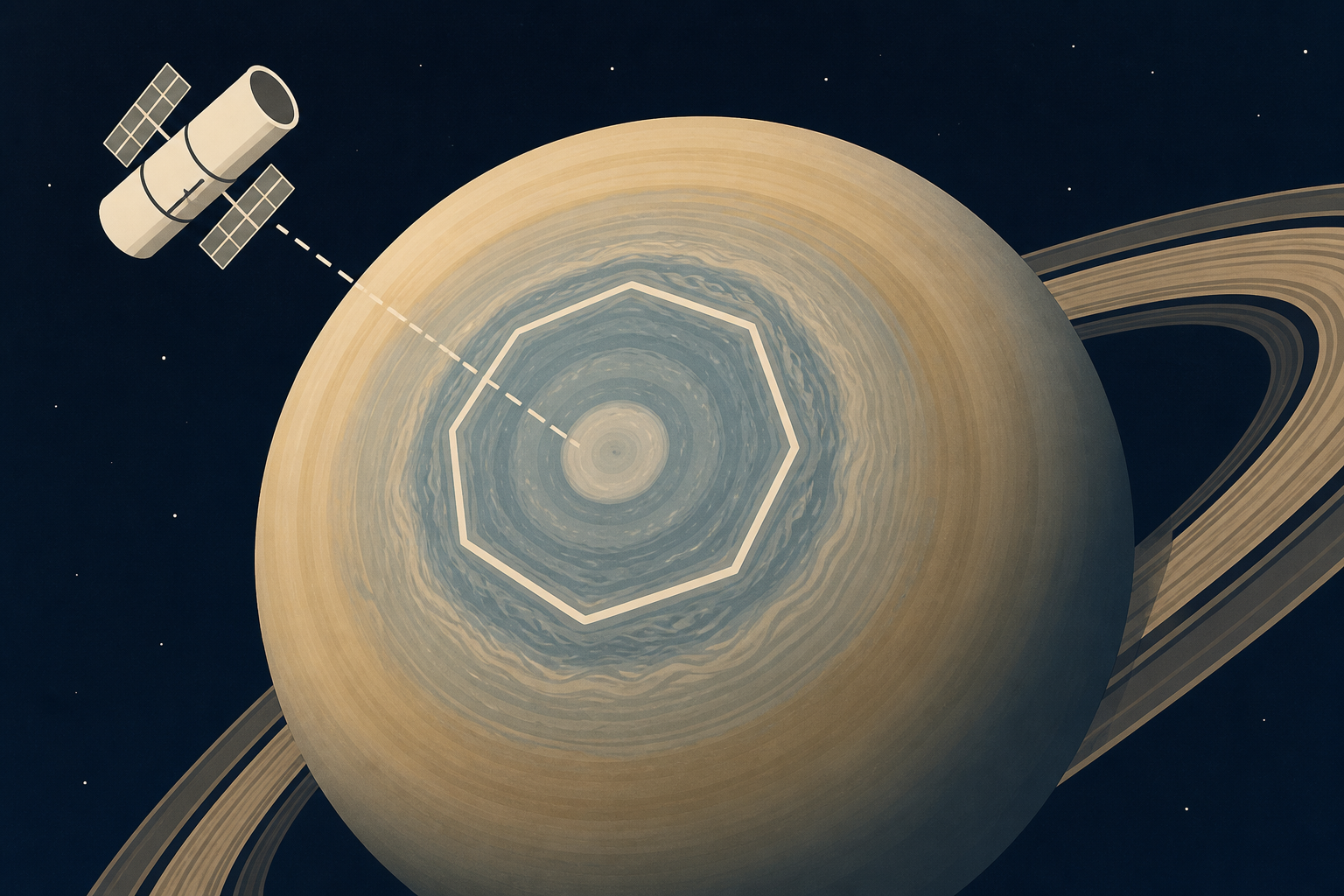
Astronomers using Hubble found a new roughly 104,000-mile-wide ten-sided storm forming at Saturn’s south pole, a geometric twin to the famous hexagon that has long circled the north
Space Daily • • general
Key Points:
- Astronomers using the Hubble Space Telescope have discovered a ten-sided polygonal wave, or decagon, encircling Saturn's south pole, measuring about 104,000 miles across, analogous to the well-known six-sided hexagon at the north pole.
- This newly observed decagon is a wave pattern locked into a fast eastward jet stream near 63 degrees south latitude and extends vertically through multiple atmospheric layers, indicating a deep-rooted atmospheric structure.
- The southern decagon was not seen during the Cassini mission (2004-2017) and appears to have emerged recently, likely due to Saturn's axial tilt and seasonal changes that limit visibility from Earth.
- The discovery challenges the previous view of the northern hexagon as a unique phenomenon, suggesting Saturn's atmosphere can form polygonal jet streams under certain conditions, with differences in polygon sides reflecting variations in jet characteristics.
- Continued monitoring by Hubble and James Webb Space Telescopes, along with atmospheric modeling, is needed to understand the decagon's origin, longevity, and dynamics, and whether it will persist like the decades-old northern hexagon.


