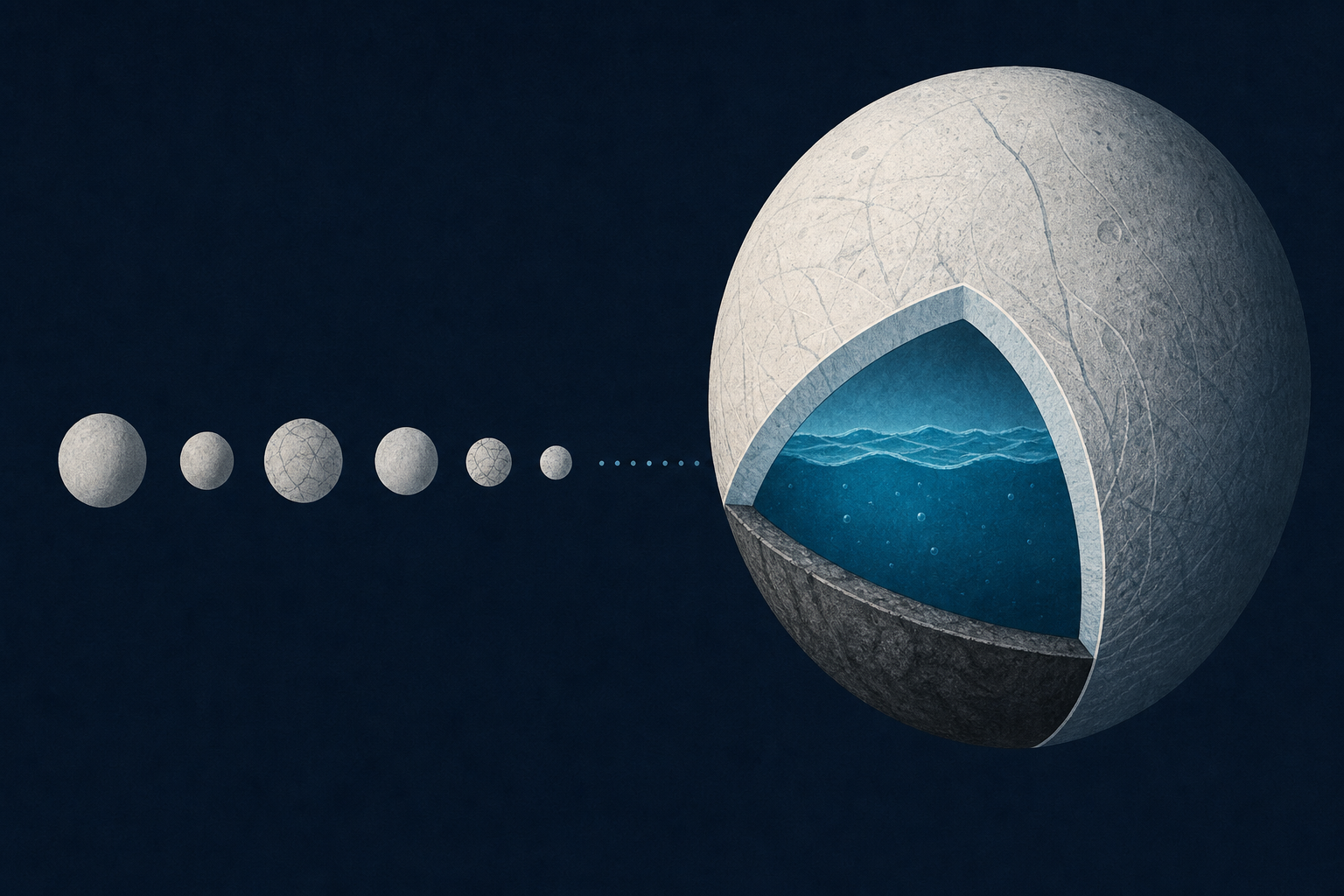
AI Generated Image
At least six moons in our solar system are thought to hide oceans of liquid water beneath their frozen surfaces — and the list may keep growing as old spacecraft data, improved models and new missions
Space Daily • • general
Key Points:
- Several moons in the outer Solar System, including Europa, Ganymede, Callisto, Enceladus, Titan, and recently Mimas, are believed to harbor subsurface oceans maintained by tidal flexing, radioactive decay, and chemical antifreezes like salts and ammonia.
- Evidence for these oceans comes from indirect measurements such as magnetic field responses, gravity data, orbital dynamics, geological features, and chemical analysis, rather than direct imaging.
- Jupiter’s moons Europa, Ganymede, and Callisto present the strongest cases, with Europa’s ocean estimated to hold more water than all of Earth’s oceans combined, while Enceladus and Titan around Saturn offer unique insights through plume sampling and surface lakes, respectively.
- Mimas was identified in 2024 as a potential ocean world based on orbital and rotational data, despite lacking visible geological activity, highlighting that subsurface oceans can exist without surface signs.
- Upcoming missions like NASA’s Europa Clipper (arriving 2030) and ESA’s Juice spacecraft (arriving 2031) will provide more detailed measurements to confirm and characterize these oceans, potentially expanding the list of known ocean worlds in the outer Solar System.


