AI Generated Image
Betelgeuse's atmosphere is becoming spotty and asymmetric-and a nearby companion could be shaping the pattern
Phys.org • • general
Key Points:
- Astronomers led by Bill Dent used the Atacama Large Millimeter Array (ALMA) to observe Betelgeuse's inner atmosphere for the first time since its dramatic dimming in 2020, revealing increased unevenness and asymmetry potentially linked to a smaller companion star.
- The 2020 event, known as the "Great Dimming," saw Betelgeuse's brightness drop by about 2.5 times, sparking questions about changes in the star's surface and atmosphere as it nears the end of its life.
- ALMA's high-resolution imaging detected hot spots up to 800 degrees hotter than surrounding areas and large convective cells on Betelgeuse's surface, with some features persisting since 2015 and aligned along a specific direction.
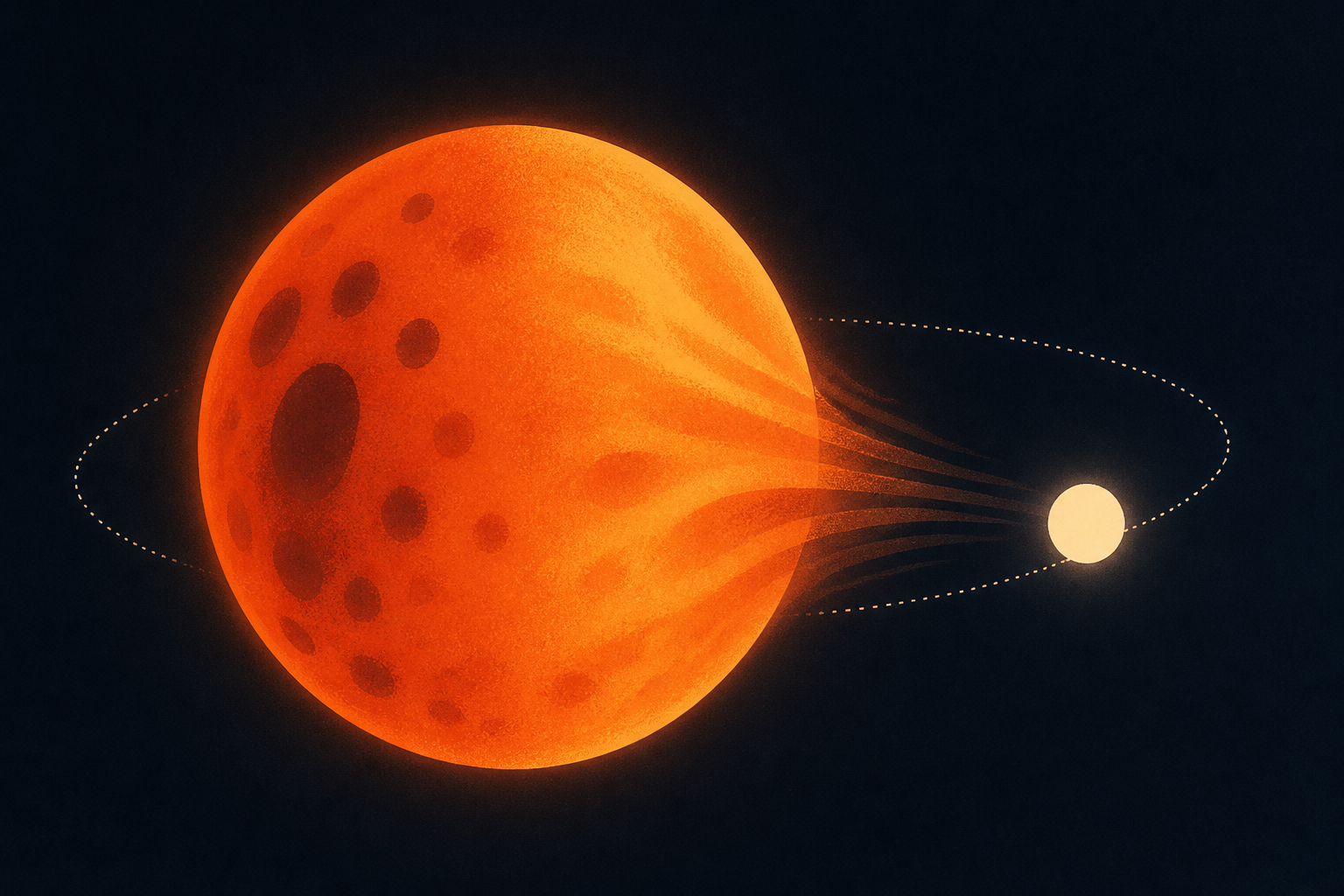
- The alignment of hot spots may be influenced by the orbit of a smaller companion star, possibly affecting convection patterns near Betelgeuse's polar regions if the orbit aligns with its equatorial plane.
- These findings could provide crucial insights into how red supergiants like Betelgeuse lose their outer layers before exploding as supernovae, with further observations planned to confirm the companion star's influence.


