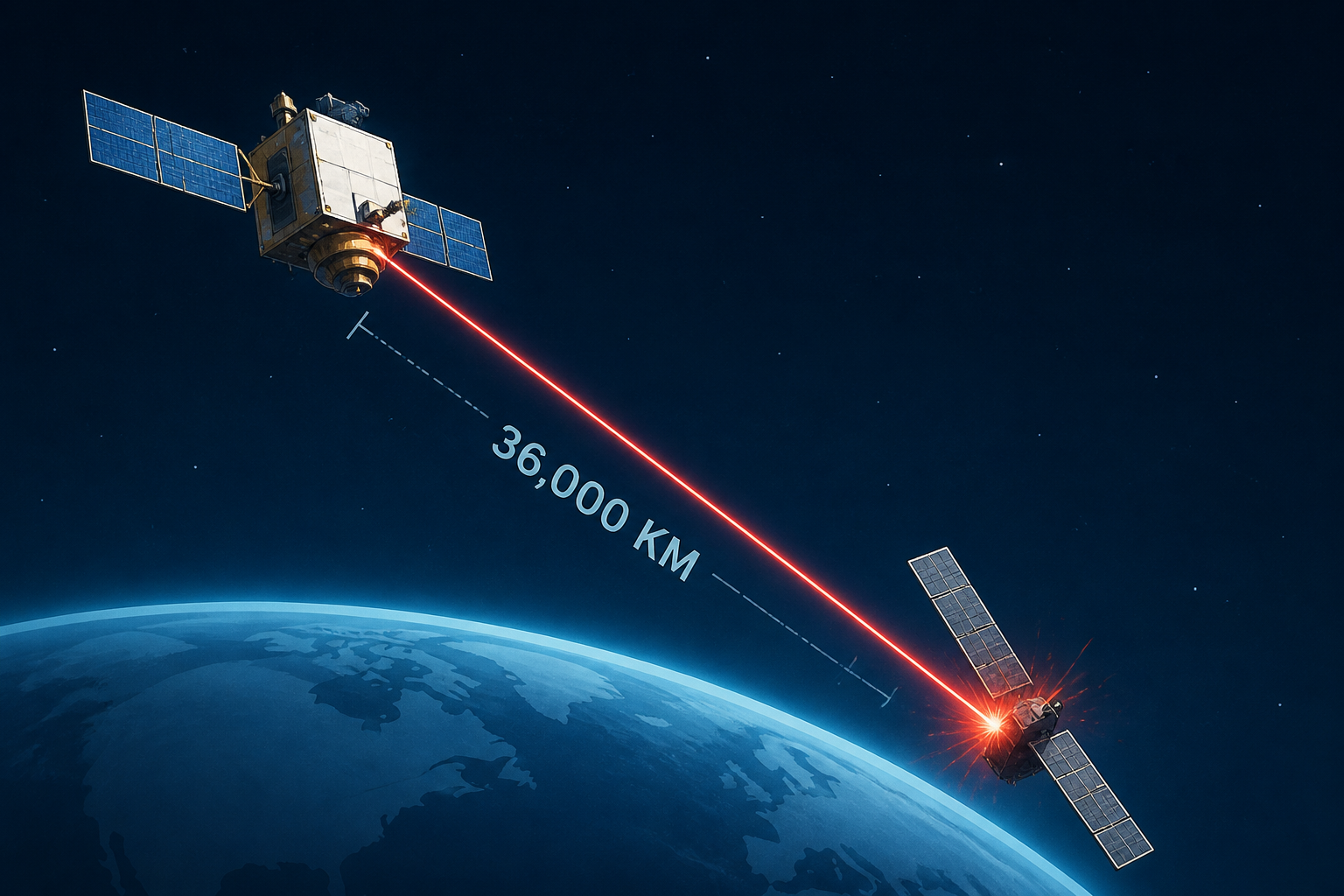
AI Generated Image
Chinese Orbiter Smashes Starlink With a Tiny 2-Watt Laser Fired From 36,000 KM Above Earth
The Daily Galaxy • • science
Key Points:
- Chinese researchers developed a combined technique called AO-MDR synergy, integrating adaptive optics and mode diversity reception to overcome atmospheric turbulence effects on laser signals from geostationary orbit.
- This approach improved the usable signal rate from 72% to 91.1%, enabling a 1 gigabit-per-second downlink using a low-power 2-watt laser transmitter from a satellite over 36,000 km above Earth.
- The experiment demonstrated significantly faster data transmission compared to Starlink, with a recorded rate five times higher, although the comparison involves different orbital distances and network conditions.
- The study highlights the challenge of atmospheric turbulence scattering and weakening laser signals and shows that combining correction methods can effectively maintain communication quality despite low signal power.
- This advancement could enhance satellite-to-ground optical communication by enabling high-speed data links from geostationary orbit, an area where previous single-method corrections were insufficient.


