AI Generated Image
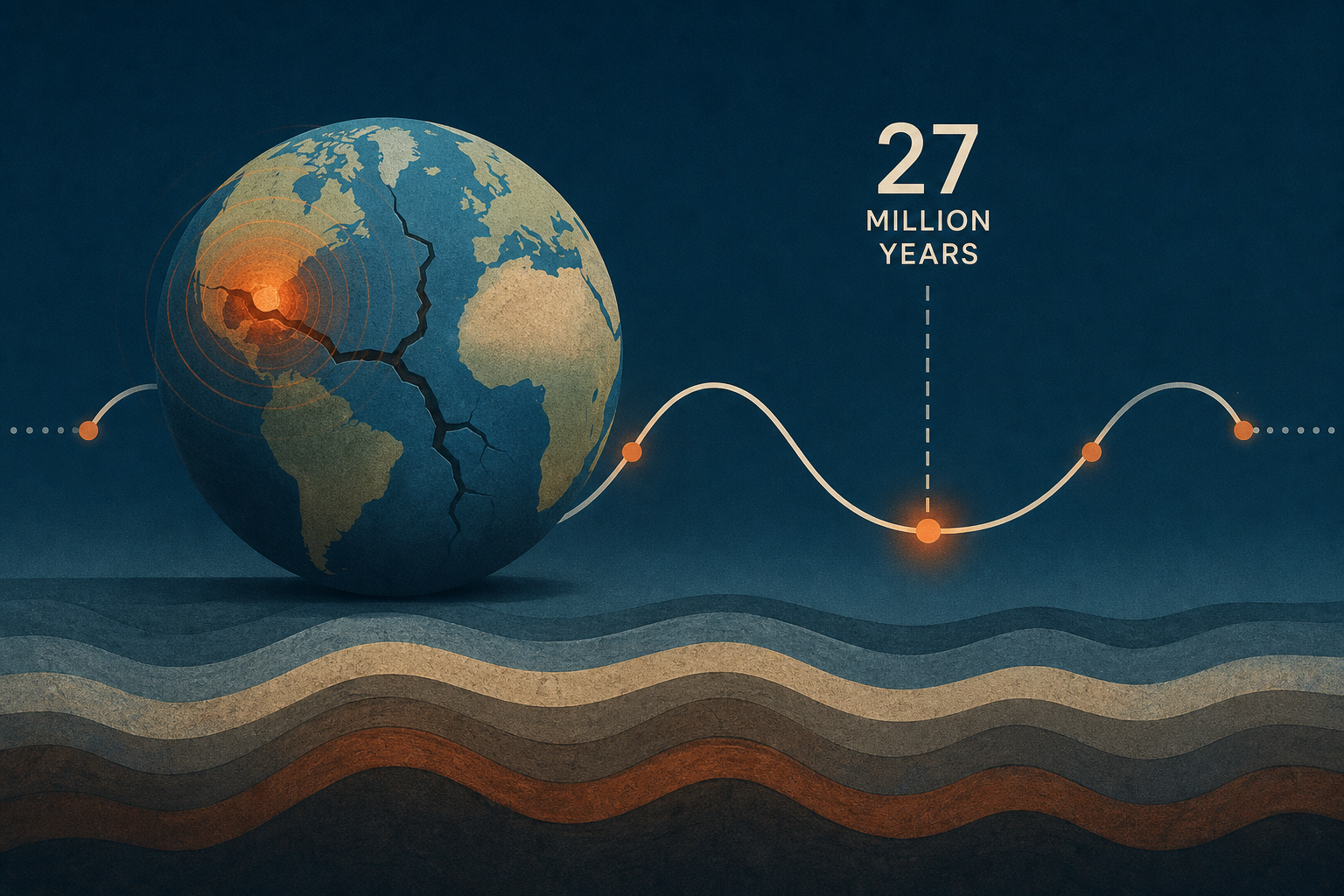
Earth's Biggest Disasters Strike in a Hidden Pattern Every 27 Million Years
Yahoo • • science
Key Points:
- A new analysis by NYU geologist Michael Rampino revisits evidence suggesting Earth's major geological disasters, including mass extinctions and volcanic eruptions, follow a roughly 27.5-million-year cycle, strengthening the case for a hidden long-term rhythm in Earth's history.
- The study examined 89 significant geological events over the past 260 million years, finding a dominant periodicity of about 27.5 million years and a weaker 8.9-million-year cycle, indicating that multiple Earth systems may periodically respond to underlying processes rather than isolated catastrophes.
- Potential drivers of this rhythm include deep Earth processes like mantle convection and mantle plumes, surface-interior interactions influenced by long-term orbital variations, and more speculative cosmic factors such as the Solar System’s oscillation through the Milky Way’s plane and possible dark matter effects.
- While large asteroid impacts were not part of the main statistical analysis, their timing appears broadly consistent with the 27.5-million-year cycle, though no causal relationship has been established, and overall evidence remains debated due to challenges with incomplete geological records and statistical uncertainties.
- Rampino emphasizes that confirming this periodicity could reshape understanding of Earth's geological history, suggesting that major upheavals are recurring phenomena linked to long-term processes, potentially integrating geological and astronomical perspectives in Earth sciences.


