AI Generated Image
European scientists create 'little Big Bang' to study the universe’s origins
New York Post • • general
Key Points:
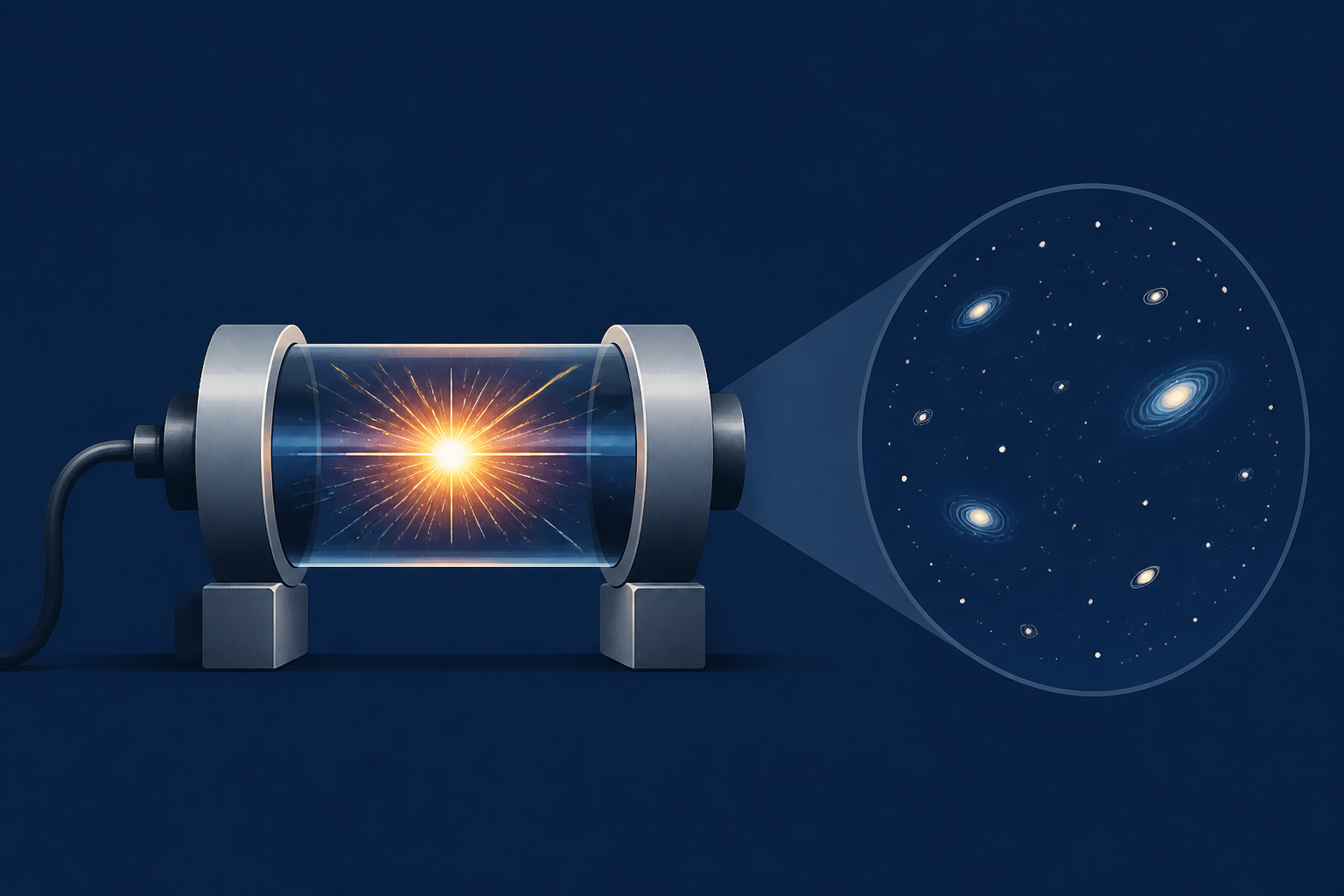
- European scientists recreated a miniature version of the early universe's quark-gluon plasma by colliding small atoms, oxygen-16 and neon-20, at near light speed, challenging the previous belief that heavy atoms like lead were necessary.
- The experiment produced a tiny droplet of quark-gluon plasma, allowing researchers to study the particles emitted after the collision, revealing distinct shapes that corresponded to the atomic nuclei’s geometry.
- Oxygen collisions resulted in a rounded particle spray, while neon collisions produced a bowling pin-shaped pattern, providing a novel way to visually infer atomic nucleus shapes.
- This research offers new insights into the primordial matter state shortly after the Big Bang and helps deepen understanding of how the early universe evolved into the matter we observe today.
- The findings, published in Physical Review Letters, support aspects of the standard Big Bang theory, although some scientists remain skeptical about the traditional "bang" concept.


