AI Image
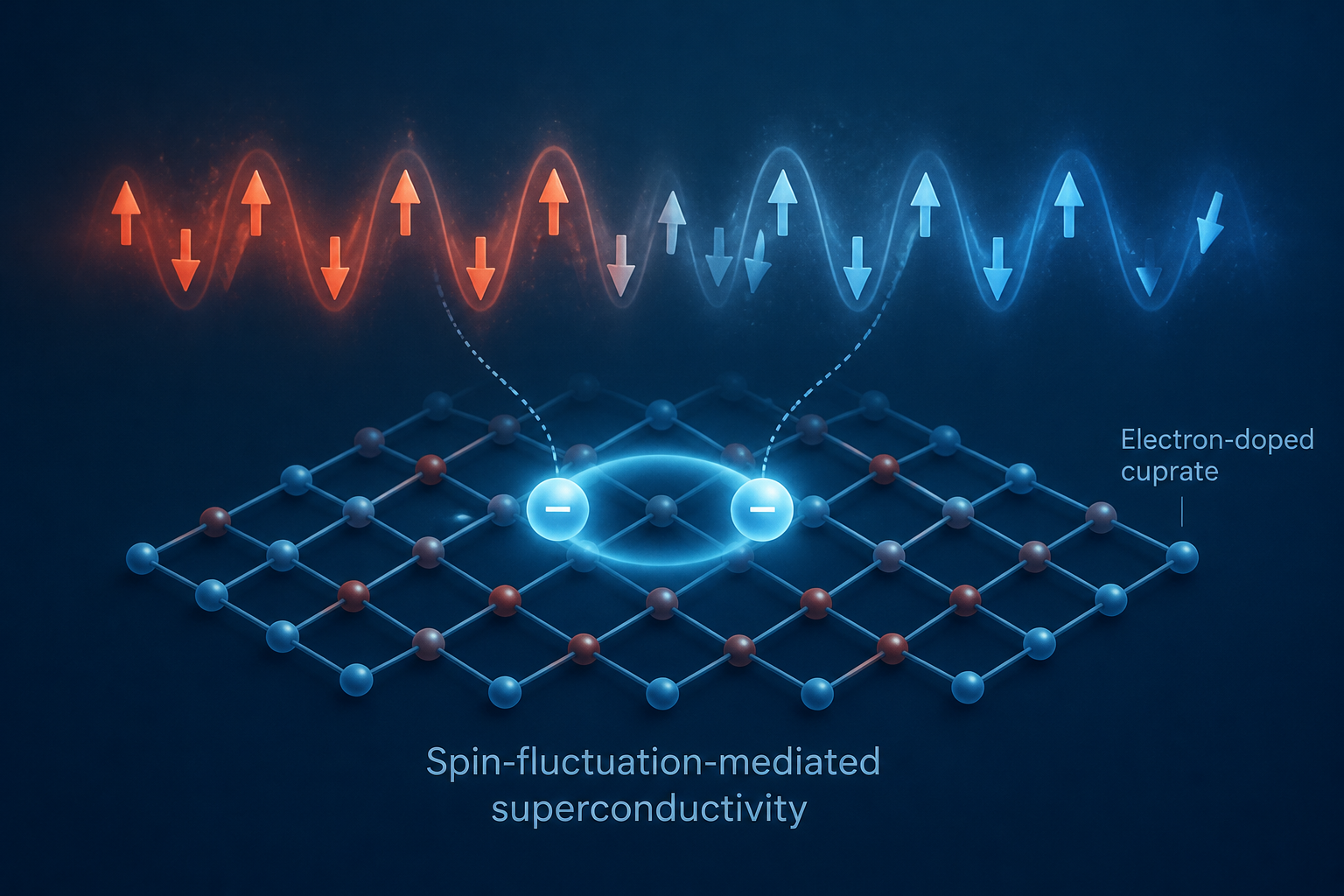
Evidence for spin-fluctuation-mediated superconductivity in electron-doped cuprates
Nature • • science
Key Points:
- A comprehensive study of magnetoresistance (MR) and in-plane resistivity in electron-doped cuprate La2−xCexCuO4 (LCCO) reveals that anisotropic, temperature-dependent inelastic scattering rates linked to antiferromagnetic (AFM) spin fluctuations dominate normal-state transport and correlate strongly with superconducting transition temperature Tc.
- The MR behavior, including a robust high-field linear MR and its unusual temperature dependence, is successfully modeled using Boltzmann transport theory incorporating anisotropic scattering with hotspots located at AFM Brillouin zone boundaries, consistent with scattering from low-energy (π, π) spin fluctuations rather than charge fluctuations.
- Incorporation of current vertex corrections (CVCs) into the Boltzmann framework explains the temperature-dependent sign change and reduction in the Hall coefficient RH, supporting the conclusion that AFM spin fluctuations mediate both the anisotropic scattering and superconducting pairing in LCCO.
- The doping-dependent coupling parameter g(x), representing the strength of the T-linear anisotropic scattering rate, decreases by an order of magnitude across the overdoped regime, mirroring the decrease in Tc and the T-linear resistivity coefficient A1, establishing a direct link between AFM spin fluctuation scattering strength and superconductivity.
- These findings highlight a fundamental difference between electron- and hole-doped cuprates: while electron-doped cuprates like LCCO conform to a quasiparticle Boltzmann transport picture with spin-fluctuation-mediated pairing, hole-doped cuprates exhibit distinct MR scaling and strange metallic behavior that likely require new theoretical frameworks beyond conventional quasiparticle approaches.


