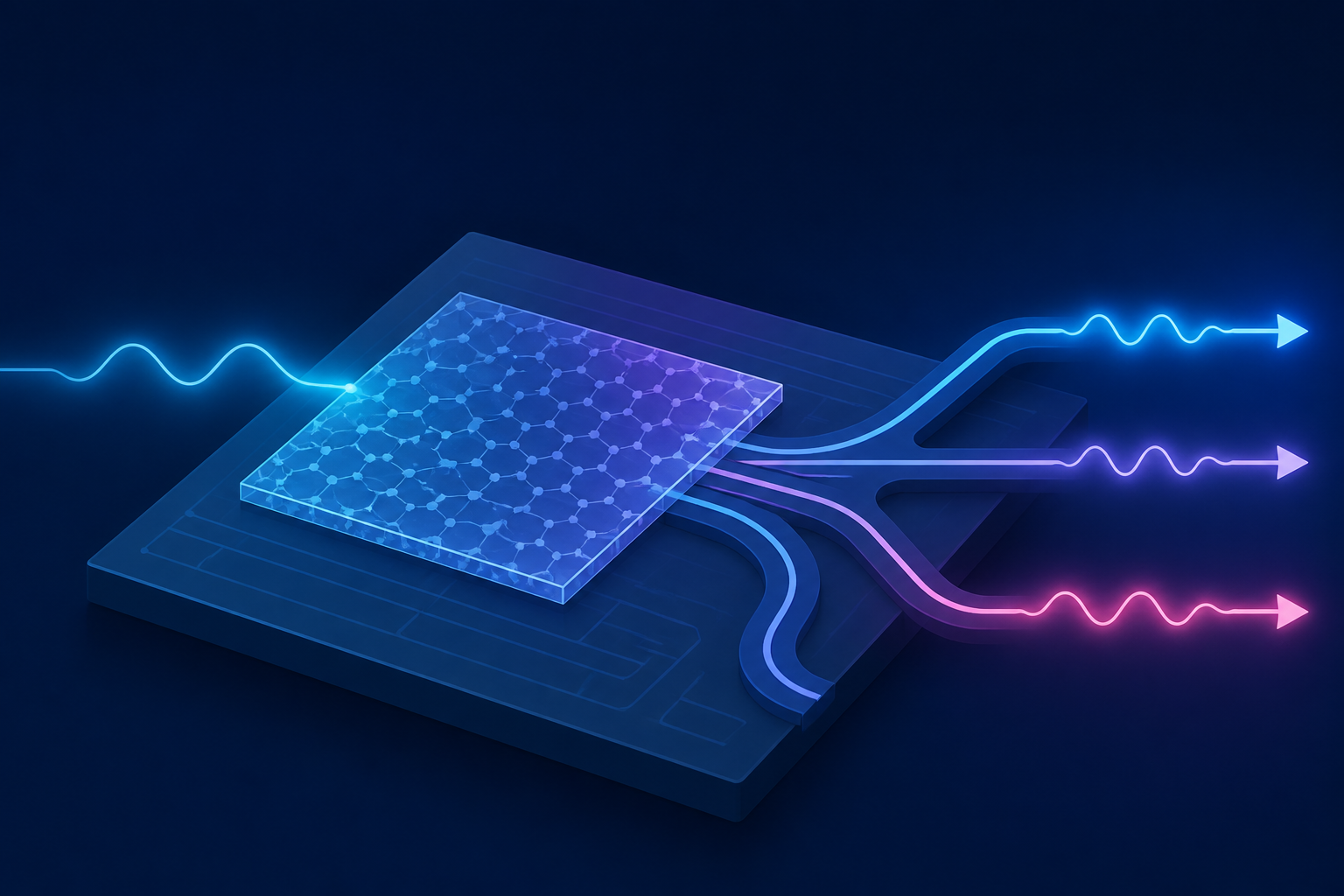
AI Generated Image
Heterogeneous photonic integration of single-crystalline nanomembranes
Nature • • technology
Key Points:
- Recent advances in photonic integrated circuits highlight continuous-travelling-wave parametric amplifiers and extended spectral ranges, enabling more efficient and versatile photonic devices (Riemensberger et al., 2022; Tran et al., 2022).
- Heterogeneous and hybrid photonic integration techniques, including van der Waals integration and remote epitaxy, are crucial for combining diverse materials like 2D materials and complex oxides, enhancing device performance and integration flexibility (Kaur et al., 2021; Liu et al., 2019; Kim et al., 2022).
- Lithium niobate and barium titanate-based photonic devices demonstrate significant progress in electro-optic modulation and frequency comb generation, offering CMOS-compatible voltages and improved electro-optic coefficients for advanced photonic applications (Wang et al., 2018; Feng et al., 2024; Abel et al., 2019).
- Integrated magneto-optical devices, including optical isolators and modulators using cobalt ferrite and yttrium iron garnet films, show promise for non-reciprocal photonic components with high endurance and cryogenic operation capabilities (Pintus et al., 2025; Serrano-Núñez et al., 2022).
- Manufacturing innovations such as high-throughput epitaxial membrane production, micro-transfer printing, and crack-free wafer-scale membrane transfer are enabling scalable fabrication of high-quality photonic and optoelectronic devices for quantum computing and display technologies (Kim et al., 2023; Moon et al., 2025; Alexander et al., 2025).


