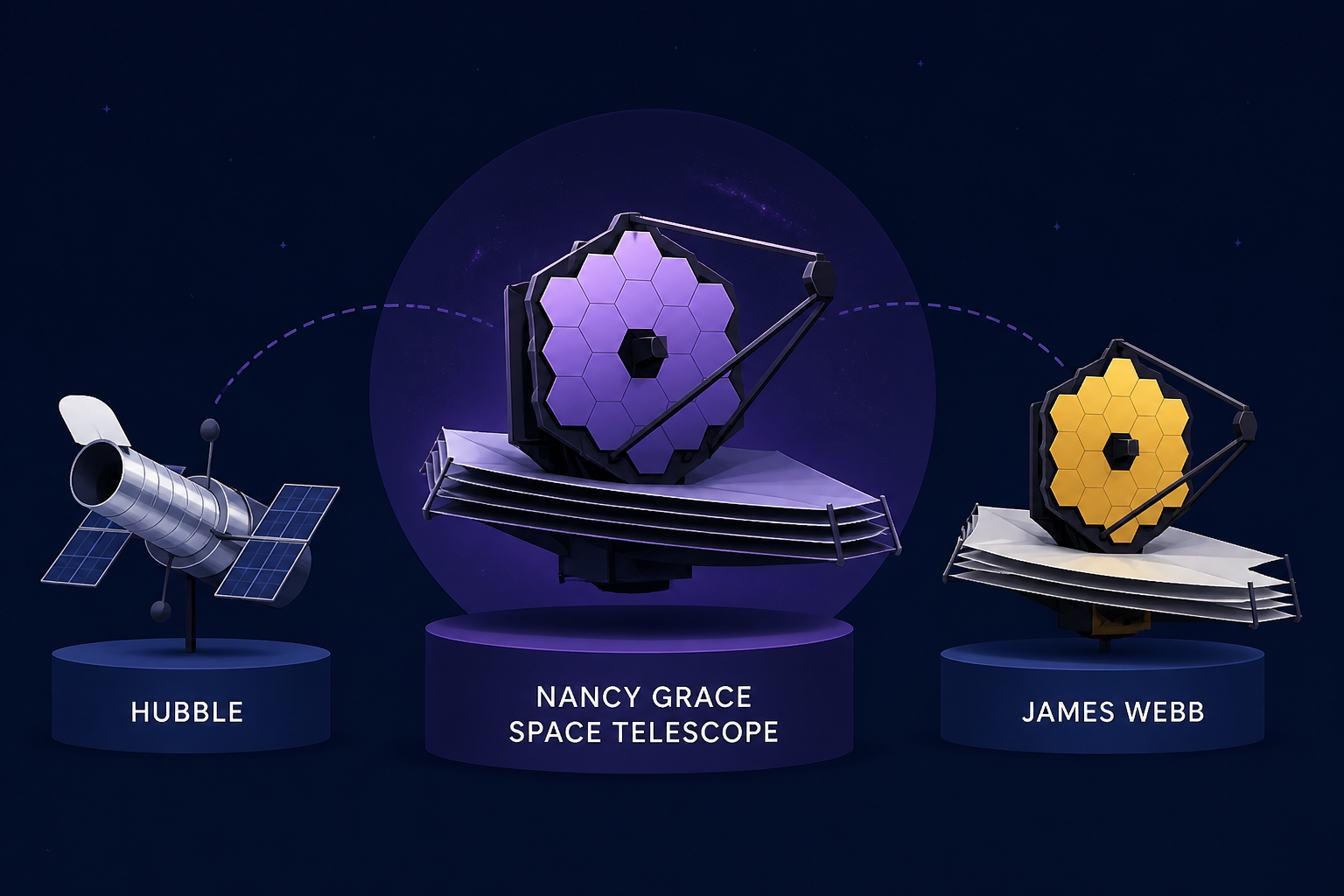
AI Generated Image
How Nancy Grace Space Telescope compares to the Hubble, James Webb
USA Today • • science
Key Points:
- NASA’s Nancy Grace Roman Space Telescope, launching on August 30 from Kennedy Space Center, will provide unprecedented wide-angle infrared views of the cosmos, capturing images 100 times larger than Hubble’s field of view with similar sharpness.
- Positioned near the Sun-Earth L2 Lagrange Point about 930,000 miles from Earth, Roman will operate in a stable, cold environment ideal for deep space observations, joining other missions like James Webb and ESA’s Euclid.
- Roman’s two main instruments include a 300-megapixel Wide Field Instrument for studying distant galaxies and cosmic expansion, and a powerful Coronagraph Instrument to directly image exoplanets by blocking starlight.
- Unlike Hubble’s zoom-like focus or James Webb’s deep infrared vision, Roman acts as a wide-angle panoramic camera, expected to observe light from over a billion galaxies and discover thousands of new exoplanets during its mission.
- Named after Dr. Nancy Grace Roman, NASA’s first chief astronomer and a pioneering figure in space-based astronomy, the telescope honors her legacy in advancing large space observatories and modern astronomy.


![People are sticking the Fitbit Air to their bodies with tape [Gallery]](https://media-cdn.cashwalklabs.io/https%3A%2F%2Fs3.us-west-2.amazonaws.com%2Fimages.cashwalklabs.io%2F0_admin%2Fnews-ai-images%2F01a04aa2-2b50-721d-b9f3-70c69d168a3d.webp?format=webp&w=120&h=80)


